





Abstract
OBJECTIVE To investigate the role of family aggregation and genetic factors of esophageal cancer (EC), including carcinoma of gastric cardia (CGC), in Cixian county, and to calculate the segregation ratio and heritability of first-degree relatives (FDR) in EC cases.
METHODS A case control study was conducted, and each of 285 esophageal cancer cases and FDR’s case history and family medical history of EC in 1415 controls was carried by home visits to compare the incidence of EC in the crowds. The family aggregation of EC was found by χ2 test for goodness of fit test according to binomial distribution. Li-Mantel-Gart method was used to calculate the segregation ratio and Falconer method was employed to compute the heritability (h2).
RESULTS The incidence rate of the FDR in the index case of EC (12.80%) was higher than that in the controls (7.52%). There were significant differences between the 2 groups (χ2= 44.34, P = 0.000). The distribution of EC in the family did not agree with the binomial distribution, which presented a conspicuous familial aggregation (χ2= 288.19, P < 0.0001). The heritability of EC was (29.67 ± 4.32)%, and segregation ratio was 0.1814 (95%CI = 0.1574-0.2054), which is lower than 0.25, and can be regarded as a disease of multi-factorial inheritance.
CONCLUSION The occurrence of EC in the Cixian County is the outcome of the mutual effect of genetic and environmental factors. The family history of upper gastrointestinal cancers increases the risk of EC in late generations.
keywords
Introduction
Cixian County is located in Taihang Mountains in the south of Hebei Province, and is a high-risk area of esophageal cancer (EC) in China. In the county, the average incidence of EC per year was 123.5/100,000 in males, and 90.7/100, 000 in females during the year 1998-2002[1]. In China before mid 1980s cardiac carcinoma was classified as EC, since the clinical symptoms and the treatment methods for both are roughly the same. Therefore, the expression of “carcinoma of esophago cardia” was commonly used to define patients with EC or cardiac carcinoma[2].
Until the last several years, the carcinoma of gastric cardia (CGC) was individually classified because of the popularization of endoscopy and the requirement of International Classification of Disease (ICD) coding. In our investigation, the statistics on EC and CGC in which both cancers were still regarded as one disease was conducted. The reasons for doing so were: i. owing to different classifications of the diagnosis, the researchers usually failed to exactly know whether EC or CGC was the disease the siblings of the investigated, especially the parents, suffered; ii. after the endoscopic biopsy, the pathological findings confirmed that there were concurrently the cancerations of esophagus and gastric cardia in part of the probands (about 4%). Therefore, in our study an investigation of new patients with EC (including CGC mentioned above) was conducted by endoscopic screening during the period from 2004 to 2005 in Cixian County. The purpose of this study was to understand the role of hereditary factors and mode of action in the incidence of EC in Cixian county.
Patients and Methods
Patients
During a period from January 1st, 2004 to December 31st, 2005, the newly diagnosed EC patients, including CGC, who had undergone endoscopic mass screenings and histological examinations in the local hospitals in the Cixian County, were selected as the probands. The investigated probands totaled 285, among which 224 were the patients with EC, 49 with CGC, and 12 with carcinoma of the esophago cardia. In the probands, 176 were males (61.8% of the totals), and 109 were females (38.2%). The inclusion criterion of the probands included the newly found patients who underwent an endoscopic screening with the final pathologic diagnosis, and the residents who had lived for over 40 years in the locality. Concurrently, 1415 residents who were confirmed to have no upper gastrointestinal tumor and precancerous lesion after endoscopic screening in the same year and had lived for over 40 years in the same region were selected as the controls.
Methods
The uniform baseline questionnaire of epidemiology was used, and a family investigation was performed by the well-trained investigators to collect the related data from the probands, the controls and the first-degree relatives (FDR) of the investigated, i.e., their parents, children, brothers and sisters. The data included the general state of health, family history (FH) of the EC (including CGC) in FDR of patients, history of the disease of digestive system, environmental factor, unhealthy hobbies, and eating habits, etc.
Quality control
The information of the investigation was supplied by the patients themselves or their spouse. Before the investigation, the investigators were unitedly trained to explain the content of the investigation and related announcements. After completion of the investigation, all items concerned were carefully checked, and a new investigation would start if any questionable information was found. In a random check, a second investigation in 10% of the subjects was conducted by different investigators, showing that all Kappa coefficients of the above indicators in the second investigation exceeded 0.75. Therefore the numerical data of this investigation could be considered reliable.
Statistical analysis
SPSS11.5 was used for data processing and statistical analysis, Kappa’s test for consistency of the data, and chi-square test or Fisher’s exact propability for comparing the morbidity rates. Binomial distribution was utilized to fit the distribution of EC, and chi-square test for goodness of fit test according to frequency distribution to decide whether the family aggregation existed.
Li-Mantel-Gart method[3] was used to calculate the segregation ratio of EC. After the tests, it was determined if there was a statistical significance in differences between the segregation ratio of the filial siblings and the theoretical segregation ratio decided by a specific mode of inheritance, and if it could be decided whether the diseases under the investigation fit the mode of inheritance.
Segregation ratio of Li-Mantel-Gart method
Segregation ratio: P = (R-J)/(T-J)
Mean square of segregation ratio: SP2 = (R-J)(T-R)/(T-J)3
Standard error of segregation ratio: SE (P) = (SP2)1/2
In the formula of 95%CI = P ± 1.96SE (P): T is the number of total siblings, R is the number of patients in the siblings, and J is the number of the family, in which there was only 1 patient in the siblings.
Estimation of the mode of inheritance by Penrose method[4]
The mode of inheritance of a disease was estimated based on the morbidity rate (MBR) of the siblings (s) and the MBR of healthy persons (q), and the mode of inheritance was judged by the following criteria: the numerical value of s/q approaching the value of 1/2q was regarded as a monogenic dominant inherited disease, s/q approaching 1/4q as a monogenic recessive inherited disease, and s/q approaching  as a disease of multifactorial inheritance.
Estimation of heritability
Falconer regression method[5] was used to calculate the heritability
Heritability: h2=b/r
Regression coefficient: b=Pc(Xc—Xr)/ac
Mean square: 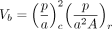
Standard error: 
In the above formulae, r stands for coefficient of relationship. The r value is 1/2 in FDR, indicating that 1/2 of the genes is possibly the same among the parents, children and siblings. X indicates normal deviation between the mean value of liability and threshold value, and a mean average deviation in the mean value of liability between the patients and healthy persons (or the controls). q stands for liability, and p stands for 1-q. A means the absolute number of patients in the relatives of the probands. The subscript r means the relatives of the patients, and the subscript c denotes the relatives of the controls.
Results
Analysis of familial aggregation
Constituent ratio of sex and age
A total of 285 proband pedigrees and 1415 control pedigrees were included in our investigation. The differences in the age and sex constituent ratios between the 2 groups were not statistically significant, see Table 1.
Age and sex constituent ratio of the proband and control pedigrees.
The state of developing EC in FDR
There was an EC FMH in their FDR of the 122 cases out of the 285 probands (42.81%). Of the 1415 controls, EC FMH in FDR was found in 473 (33.43%). The differences between the 2 groups were statistically significant (χ2 = 9.17, P = 0.002). The MBR of EC in FDR was 12.80% (168/1312) in the probands and was 7.52% (525/6984) in the controls. So, the risk of developing EC in FDR of the probands was significantly higher than those of the controls (χ2 = 40.34, P < 0.0001). The Odd Ratio (OR) value was 1.81, and 95%CI was 1.50-2.71.
The test for goodness of fit of the family aggregation
It was found that, after chi-square test for goodness of fit according to binomial distribution, the distribution of EC was not in accordance with the binomial distribution in the family, presenting an apparent family aggregation (χ2 = 288.19, P < 0.0001), see Table 2.
Chi-square test for goodness of fit according to binomial distribution of family aggregation in FDR.
Estimation of genetic modes of EC
Segregation analysis
In the 285 EC pedigrees, and the total number of the siblings was 1186, among which, 378 were EC patients. In the siblings, the number of the household with only 1 EC case was 199, see Table 3. The segregation ratio was calculated, P = (R-J)/(T-J) = (378-199)/(1186-199) = 0.1814, and 95%CI was 0.1574-0.2054. The segregation ratio of EC was less than 0.25 which was the theoretical value of the segregation ratio in the mode of dominant inheritance of single gene, suggesting that EC was not inherited based on the monogenic mode of inheritance.
Segregation analysis of FDR in the pedigree of EC probands.
Estimation of mode of inheritance using Penrose method
It was shown in the estimation of mode of inheritance that the MBR in the controls (q) was 7.52%, and the MBR in the siblings (s) was 31.87%. The specific value (s/q) was 4.24, the dominant (1/2q) 6.65, the recessive (1/4q) 3.32, and the multigenic ( ) 3.65. The results were in agreement with that of the segregation analysis, and s/q (4.24) was most close to
  (3.65), which suggested that EC was the disease of multi-factorial inheritance.
Estimation of the heritability in FDR of the probands
The investigation showed that the MBR of EC was 12.80% in the FDR of the EC patients, and was 7.52% in the FDR of the controls. After computation, the heritability was (29.67±4.32) % in FDR, indicating that the cases in Ci-xian County, Hebei Province have definite hereditary susceptibility, See Table 4.
Estimation of MBR of EC and heritability in FDR.
Multifactorial and unconditional logistic regression analysis of influencing factor on EC
The dominant variables selected from the monofactorial analysis were introduced into the multifactorial and unconditional logistic regression analysis. The results showed that the following persons had the risks of developing EC, i.e., the unmarried persons, including the singles over 30 years of age, the divorced and those with loss of spouse, the people drinking water from ponds, shallow wells, lake, or river, (in comparison with the deep-well water, fountain and tap water), or with favor of hot food, and the FDR of the probands. A high systolic blood pressure (SBP) was the risk factor of developing EC. The preventive factors of developing EC included the followings: female, persons with high educational level and economic income, frequent intake of fresh vegetables and beans, and rapid heart beat. See Table 5.
Multifactorial and unconditional logistic regression analysis of influencing factor on EC.
Discussion
As all know, diseases with a heritability of more than 70% can be regarded as the disease of high heritability, which is influenced greatly by genetics. The heritability of < 20% indicates that the occurrence of the disease mainly results from the factors, such as environmental agents, and in this case, hereditary factor plays a less role in developing EC. It was shown in our investigation that in the Cixian County of Hebei Province, China, the heritability of the FDR with esophageal cancer was (29.67±4.32) %, suggesting that the hereditary factor may play a definite role in the onset of esophageal cancer in the County.
The Falconer regression for calculating the heritability includes 2 methods, i.e., the case control study and the cross-check analysis of the case and population risks. Based on the comparative analyses of the heritability among the patients from several high-risk areas of esophageal cancer, such as Dongping, Shandong Province [6], Huai-an, Jiangsu Province[7], and the Nan Ao islands, Chaoshan region, and Shantou area in Guangdong Province[8] etc., we have found that there are big differences in the heritability of EC from one place to another in China. The reason may be that the methods used to estimate the heritability are different. Some authors took MBR in local people as the controls. Since the age of onset in most of EC patients was over 40, the heritability attained may be slightly higher. In our study, the inhabitants as the controls coming from the same village where the index cases were selected, had the same distribution of the age and gender, and environmental factors were eliminated as much as possible. Therefore, the obtained heritability may reflect the actual situation.
Although the hereditary factors play an important role in the incidence of EC, the effect of some environmental risk factors and unhealthy habits or life styles should not be neglected. Based on the analysis of the investigation, we have learned that EC frequently occurs in the males, usually in the families with a very low education level and low economic income, and the factors, such as drinking the water from ponds, shallow wells and lake or river, favor of hot foods, and having FMH of hypertensive disease or tumors etc., and these factors may increase the chances of developing EC. However, female, high education level, favorable living condition of the family, drinking deep-well and tap water, and taking plenty of fresh vegetables and beans are considered as preventive factors against developing EC.
Xu et al.[9] put forward the idea of “Nitrogen Cycle Hypothesis” and believed that nitrate and nitrite, the 2 kinds of precursors from the nitrogen cycle in nature, e.g. the amine and acid amide in the agricultural fertilizer and sewage, mainly relied on the rivers for their migration, and entered the body by various pathways to synthesize the nitrogen-nitroso compound, which brought about cancers in the esophagus, stomach, liver and other organs. Han et al.[10] authenticated the hypothesis by an experiment in which both the morbidity and mortality rate of EC decreased after change of the springhead of the drinking water. It was also found in our research that drinking the deep-well and tap water was one of the preventive factors against developing EC, and is in agreement with the above findings.
It was also found in our study that single persons over 30 years, divorced, and those with loss of spouse were in the high risk group of developing EC, and large number of cancer patients in FDR also increased the risk of developing EC. This group of people included single persons over 30 years, divorced and those with loss of spouse, or those with their relatives diagnosed as cancer who might have suffered psychic pain or psychic trauma. It was reported in previous study[11] that stress and suppression could cause a change to the cerebral mantle and hypothalamus, and could directly or via immune system decrease body’s ability to fight tumors, thus increasing the risk of developing a tumor.
In conclusion, the onset of EC is the outcome of many factors interaction, such as environment, heredity, and life style etc. Therefore, it is recommended that a regular physical examination be performed in the inhabitants of high-risk area, and that unhealthy life styles be altered in order to lower the MBR of EC.
Conflict of interest statement
No potential conflicts of interest were disclosed.
- Received September 21, 2009.
- Accepted November 23, 2009.
- Copyright © 2010 by Tianjin Medical University Cancer Institute & Hospital and Springer
In this issue


Jump to section
Related Articles
Cited By...
- No citing articles found.