





Abstract
OBJECTIVE Ginsenoside Rg3 (Rg3) has shown anti-tumor effects on various tumor cells. It has been widely used in China for non-small cell lung cancer (NSCLC). However, there are only a few clinical trials to study the effectiveness of Rg3 on NSCLC, and almost them are small-samples, so we performed a meta-analysis on the results of the studies we collected in order to investigate the effectiveness of Rg3 on NSCLC.
METHODS A meta-analysis was conducted in all the selected randomized controlled trials evaluating the effectiveness of Rg3 on NSCLC patients. All on-line databases regarding Rg3 from 1950 to 2011 were searched. Supplemental hand searching of the references of retrieved articles was performed.
RESULTS Six trials met the inclusion criteria. Four of them compared chemotherapy plus Rg3 with chemotherapy alone, and the other 2 compared chemotherapy plus Rg3 with chemotherapy plus placebo. These trials are homogeneous. Two of the trials report overall survival, but the data are not suitable for a meta-analysis. After meta-analysis was conducted in the included studies comparing the effects of chemotherapy plus Rg3 with that of chemotherapy alone or chemotherapy plus placebo, it was suggested that chemotherapy plus Rg3 increased the response rate [odds ratio: 2.64 (95% CI: 1.70–4.11), fixed effects model] and disease control rate [odds ratio: 3.34 (95% CI: 1.92–5.81); fixed effects model] of the patients at stage II–IV, especially for the patients at stage III–IV.
CONCLUSION Meta-analysis of the available evidence suggests that Rg3 plus chemotherapy improves the response rate of NSCLC patients, and well-designed RCTs with large sample size are needed.
keywords
Introduction
Lung cancer is the leading cause of cancer death in China and the worldwide[1,2]. There has been a continuously increasing trend of lung cancer incidence in China, and China is anticipated to become the country with largest number of lung cancer patients by 2025[3]. Non-small cell lung cancer (NSCLC) accounts for 80% of all lung cancer cases and are divided into such subtypes as adenocarcinoma (the subset of bronchioloalveolar carcinoma), squamous cell carcinoma and large cell carcinoma.
As far as 1983, it was found that extract of red ginseng reduced the incidence of lung adenoma[4]. Ginsenosides (GS) are the major active components of ginseng. Some researches have demonstrated that 20 (R)-GS-Rg3 (Rg3), an important component of GS, has antitumor effects on several kinds of cancer cells[5–8], especially on lung cancer cells[9,10]. In vitro studies have also revealed that Rg3 could increase the intracellular accumulation of drugs by means of binding to P-glycoprotein which is associated with multidrug resistance[11,12].
Based on the results of some randomized control trials (RCTs), Rg3 (trade name: Shengyi capsule) has been recommended in the Chinese edition of National Comprehensive Cancer Network (NCCN) guideline for relapse or metastasis of the NSCLC patients as an anti-angiogenesis drug as well as a bevacizumab since 2006. However, the sample size in all the studies are small, therefore, it is necessary to perform a meta-analysis to evaluate the effectiveness and safety of Rg3 in NSCLC patients.
Materials and Methods
Search strategy
Each of such keywords as Rg3, ginsenoside, ginseng or Shengyi capsule, along with lung cancer or non-small cell lung cancer and RCTs were entered when searching in the following electronic databases: (1) MEDLINE (August 1960 to February 2011); (2) EMBASE (Janurary 1966 to February 2011); (3) Chinese VIP database (Janurary 1989 to February 2011); (4) EBM review; (5) Current Controlled Trials (www.controlled-trials.com); (6) The National Research Register (www.update-software.com/National/nrr-frame.html); (7) Clinicaltrials (clinicaltrials.gov).
Outcomes evaluation
The primary outcome was evaluated with response rate (RR) and the secondary outcomes evaluated with overall survival (OS), disease control rate (DCR, including the complete and partial response, plus stable disease and minor response if there is), time to progression (TTP), and progression-free survival time (PFS).
Statistical analysis
Meta-analysis was carried out by using review manager (RevMan 4.2) with fixed or random effects models, odds ratios (OR) and 95% confidence intervals (CI) were calculated. Weighted mean difference (WMD) was computed for continuous variable.
Methodology of the included studies
Based on the methods of randomization, allocation concealment, blinding and loss to follow up, the methodological quality of the included studies were assessed.
Results
Of the 403 articles identified in the literature search, only 8 articles related to RCTs were suitable to this analysis. After discussion, 2 articles were excluded, and one of them analyzed the effects of CTX plus Rg3 and Rg3 alone for post-chemotherapy patients[13], and the other only presented randomization of study in its abstract without further description in the main body of the article[14]. Four out of 8 presented clinical trials which compared the effects of chemotherapy plus Rg3 with chemotherapy alone[15–18]. The remaining 2 described clinical trials in which the effects of chemotherapy plus Rg3 and chemotherapy plus placebo were compared[19,20]. Details of the included studies presented in the 6 collected articles are summarized in Table 1. All the included studies had a total of 496 participants, and 3 of them included lung cancerpatients at stage II–III while the other 3 included the patients at stage III–IV.
The basic information of the collected studies.
Primary and secondary outcomes
Table 2 shows the results of the included studies. The duration of the studies varied from 6 weeks to 3 years and the longest one was 3 years[19] followed by another one of 1.6 years[20]. One of the studies listed Median TTP, median OS, 1 and 2 year survival rates, and one expressed median OS and mean OS as mean ± SD. All the included studies showed CR, PR and SD, and 3 of them presentd MR which was regarded as SD in this analysis.
The results of the collected studies.
Methodological quality of the studies
Table 3 summarizes the quality of the 6 studies. All of the trials demonstrated the randomization and 2 of them were regarded appropriate. The method applied in one of the studies was quasi-randomization because the patients were distributed based upon the assigned date (even or odd). Allocation concealments were unclear in all the 6 included studies. Blinding was applied in 2 of the studies[19,20], and both were double-blind. One of the studied reported 9 patients drop-out[20].
The quality of the main elements in collected studies.
Effects of chemotherapy plus Rg3 vs. chemotherapy alone or chemotherapy plus placebo
Response rate and disease controlled rate
All the response rates and disease control rates in all the included trials were evaluated with meta-analysis. These studies formed the basis for determining the effectiveness of chemotherapy+Rg3. The results of the meta-analysis showed an OR of 2.64 (95% CI: 1.70–4.11) for RR in favor of chemotherapy+Rg3 (P<0.001) and an OR of 3.34 (95% CI: 1.92–5.81) for DCR in favor of chemotherapy+Rg3 (P<0.001) (Fig.1).

The effect of Rg3 in non-small cell lung cancer. RR: response rate, DCR: disease control rate, OR: odds ratios, n: number of incidence events of group. N: number of patients.
Overall survival
Overall survival was measured in the 2 long-term studies[18,19]. However, the meta-analysis was not applied to evaluate the OS in the 2 studies because of the limited data.
Subgroup analysis
Subgroup analysis for the patients at stage III–IV were conducted. 3 of the included trials composed of the patients at stage II, one of them included 1 patient at stage II in chemotherapy plus placebo group, we excluded the patient regarding it as ineffective. Thus, only the patients at stage III–IV were remained in that trail and the data of the patients could be analyzed along with those in the other 3 trials which included the patients at stage III–IV only. The results showed that there was no heterogeneity in the 4 studies (P=0.76) with an OR of 2.41(95% CI 1.43–4.07) (P=0.001) for RR in favors of chemotherapy+Rg3. For DCR, there was no heterogeneity in the 4 studies (P=0.51) with an OR of 2.69 (95%CI 1.34–5.04) in favors of chemotherapy +Rg3 (P=0.005).
Safety analysis
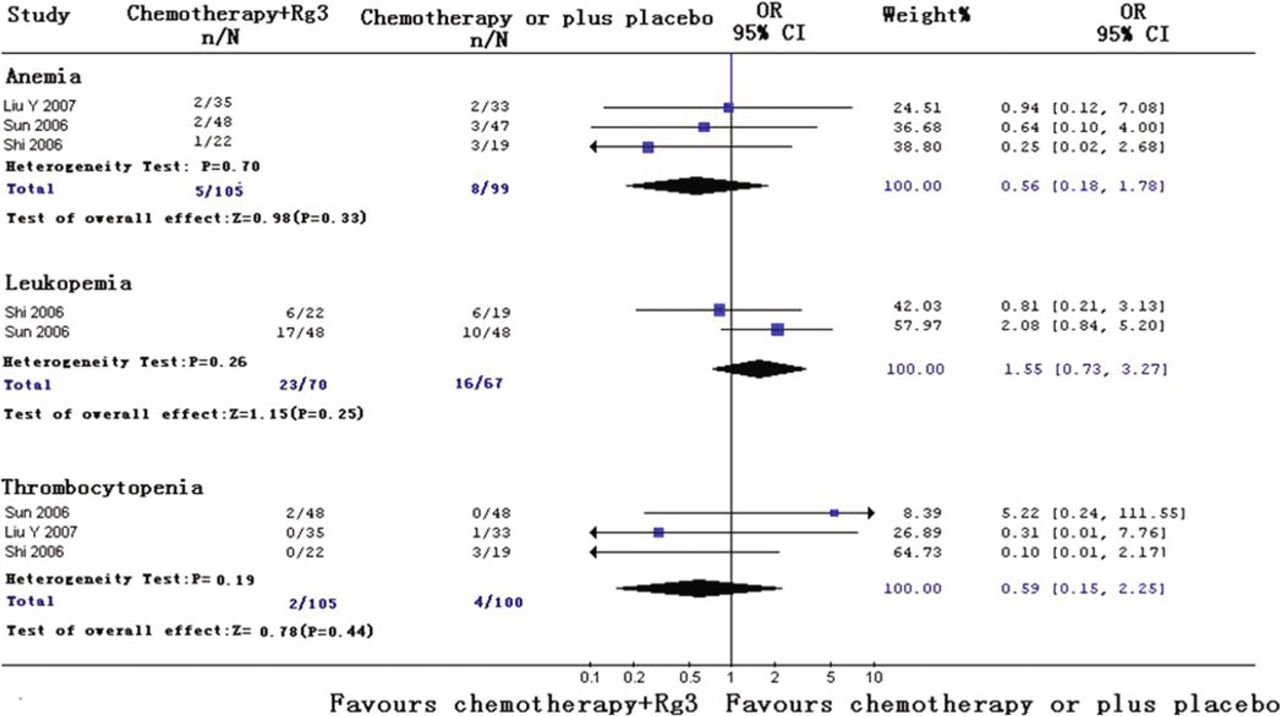
One of the studies reported that 9 patients were of dropout (4 patients abandoned at the beginning of the study and 5 suffered from serious adverse effects), and no further details were found[20]. Three of the trials reported that hematologic toxicity occurred in the patients. Thus, meta-analyses was conducted for analyzing hematologic toxicity at degree III–IV. There were no statistical difference among anemia, leukopenia and thrombocytopenia. For anemia at degree III–IV, the OR was 0.56 (95% CI: 0.18–1.78) (P=0.33); for leukopenia at degree III–IV, the OR was 1.55 (95%CI 0.73–3.27) (P=0.25); for thrombocytopenia at degree III–IV, the OR was 0.59 (95% CI 0.15–2.25) (P=0.44) (Fig. 2).

III–IV degree hematologic toxicity of chemotherapy + Rg3 vs. chemotherapy or plus placebo. n: number of incidence events of group. N: number of patients.
Discussion
Angiogenesis is required in invasive growth and metastasis of tumor and regarded as a key point in cancer progression. Anti-angiogenic drugs may improve the effects of chemotherapy by causing “vessel normalization” and angiogenesis inhibitors normalize tumor endothelial cell’s responsiveness to inflammatory cytokines in vivo[21]. Based on the result of ECOG 4559[22], bevacizumab combined with paclitaxel and cisplatin has been recommended by Eastern Cooperative Oncology Group (ECOG) for recurrent or advanced non-squamous NSCLC patients. Rg3 has been recommended in Chinese edition of NCCN guideline as an anti-angiogenesis drug for advanced NSCLC patients. Our analysis suggests that NSCLC patients at stage III–IV can get benefits when Rg3 combined with chemotherapy is applied. The patients at stage II–IIIa, whose tumor are operable, may also be benefited with Rg3 too. One study including 133 patients observed life span of the post-operative patients at stage II–IIIa, and showed that there were no statistical differences in 1-year, 2-year and 3-year survival among the patients receiving Rg3 or the patients receiving chemotherapy alone or the patients receiving Rg3 plus chemotherapy[23]. Although most studies are in short term, which makes meta-analysis for evaluating the long-term effects is unapplied, the 2 long-term studies both showed that the patients aquired benefits from the treatment of Rg3 plus chemotherapy on their long-term survival. Increased treatment-related deaths, neutropenia, possible bleeding and thrombocytopenia induced by bevacizumab are noticeable, while our analysis suggests that combination of chemotherapy and Rg3 does not increase hematological toxicity. In the included studies there were no descriptions about hypertension, which is regarded as a useful surrogate to predict the usability of bevacizumab. The cost of Rg3 in China is much less than that of bevacizumab. Cost effectiveness of Rg3 needs to be taken into consideration following the effect which has been proven. The anti-tumor mechanism of Rg3 is not very clear. Whether Rg3 can normalize vessels or overcome endothelial cell anergy and whether other anti-angiogenesis drugs, such as bevacizumab and endostatin can do the same are still unknown. All the included patients in the studies are Chinese. Considering the different effect of chemotherapy on NSCLC patients in different race groups, this modality of the treatment should be considered carefully when it is applied to different race of the patients. The methodological quality of the included studies is not high, and the sample size is small, so we conducted a meta-analysis to evaluate the effects of Rg3 in NSCLC patients. However, large-sample RCTs are necessary to conform the anti-tumor effects of Rg3.
Conflict of interest statement
No potential conflicts of interest were disclosed.
- Received May 25, 2011.
- Accepted August 11, 2011.
- Copyright © 2011 by Tianjin Medical University Cancer Institute & Hospital and Springer
In this issue


Jump to section
Related Articles
Cited By...
- No citing articles found.