

Main menu

  • Home
  • About
    • About CBM
    • Editorial Board
    • Announcement
  • Articles
    • Ahead of print
    • Current Issue
    • Archive
    • Collections
    • Cover Story
  • For Authors
    • Instructions for Authors
    • Resources
    • Submit a Manuscript
  • For Reviewers
    • Become a Reviewer
    • Instructions for Reviewers
    • Resources
    • Outstanding Reviewer
  • Subscription
  • Alerts
    • Email Alerts
    • RSS Feeds
    • Table of Contents
  • Contact us
  • Other Publications
    • cbm

User menu

  • My alerts

Search

  • Advanced search
Cancer Biology & Medicine
  • Other Publications
    • cbm
  • My alerts
Cancer Biology & Medicine

Advanced Search


  • Home
  • About
    • About CBM
    • Editorial Board
    • Announcement
  • Articles
    • Ahead of print
    • Current Issue
    • Archive
    • Collections
    • Cover Story
  • For Authors
    • Instructions for Authors
    • Resources
    • Submit a Manuscript
  • For Reviewers
    • Become a Reviewer
    • Instructions for Reviewers
    • Resources
    • Outstanding Reviewer
  • Subscription
  • Alerts
    • Email Alerts
    • RSS Feeds
    • Table of Contents
  • Contact us
  • Follow cbm on Twitter
  • Visit cbm on Facebook
Review ArticleReview

Personalized immunotherapy in cancer precision medicine

Kazuma Kiyotani, Yujiro Toyoshima and Yusuke Nakamura
Cancer Biology & Medicine November 2021, 18 (4) 955-965; DOI: https://doi.org/10.20892/j.issn.2095-3941.2021.0032
Kazuma Kiyotani
1Project for Immunogenomics, Cancer Precision Medicine Center, Japanese Foundation for Cancer Research, Tokyo 135-8550, Japan
  • Find this author on Google Scholar
  • Find this author on PubMed
  • Search for this author on this site
Yujiro Toyoshima
1Project for Immunogenomics, Cancer Precision Medicine Center, Japanese Foundation for Cancer Research, Tokyo 135-8550, Japan
  • Find this author on Google Scholar
  • Find this author on PubMed
  • Search for this author on this site
Yusuke Nakamura
1Project for Immunogenomics, Cancer Precision Medicine Center, Japanese Foundation for Cancer Research, Tokyo 135-8550, Japan
  • Find this author on Google Scholar
  • Find this author on PubMed
  • Search for this author on this site
  • ORCID record for Yusuke Nakamura
  • For correspondence: yusuke.nakamura{at}jfcr.or.jp
  • Article
  • Figures & Data
  • Info & Metrics
  • References
  • PDF
Loading

Article Figures & Data

Figures

  • Tables
  • Figure 1
    • Download figure
    • Open in new tab
    • Download powerpoint
    Figure 1

    Summary of frequency of actionability and patients’ response rates in genomic profiling-based clinical trials. Approximately 40% of the patients had potentially actionable mutations/alterations, but only 10%–15% were treated with genotype-guided appropriate drugs.

  • Figure 2
    • Download figure
    • Open in new tab
    • Download powerpoint
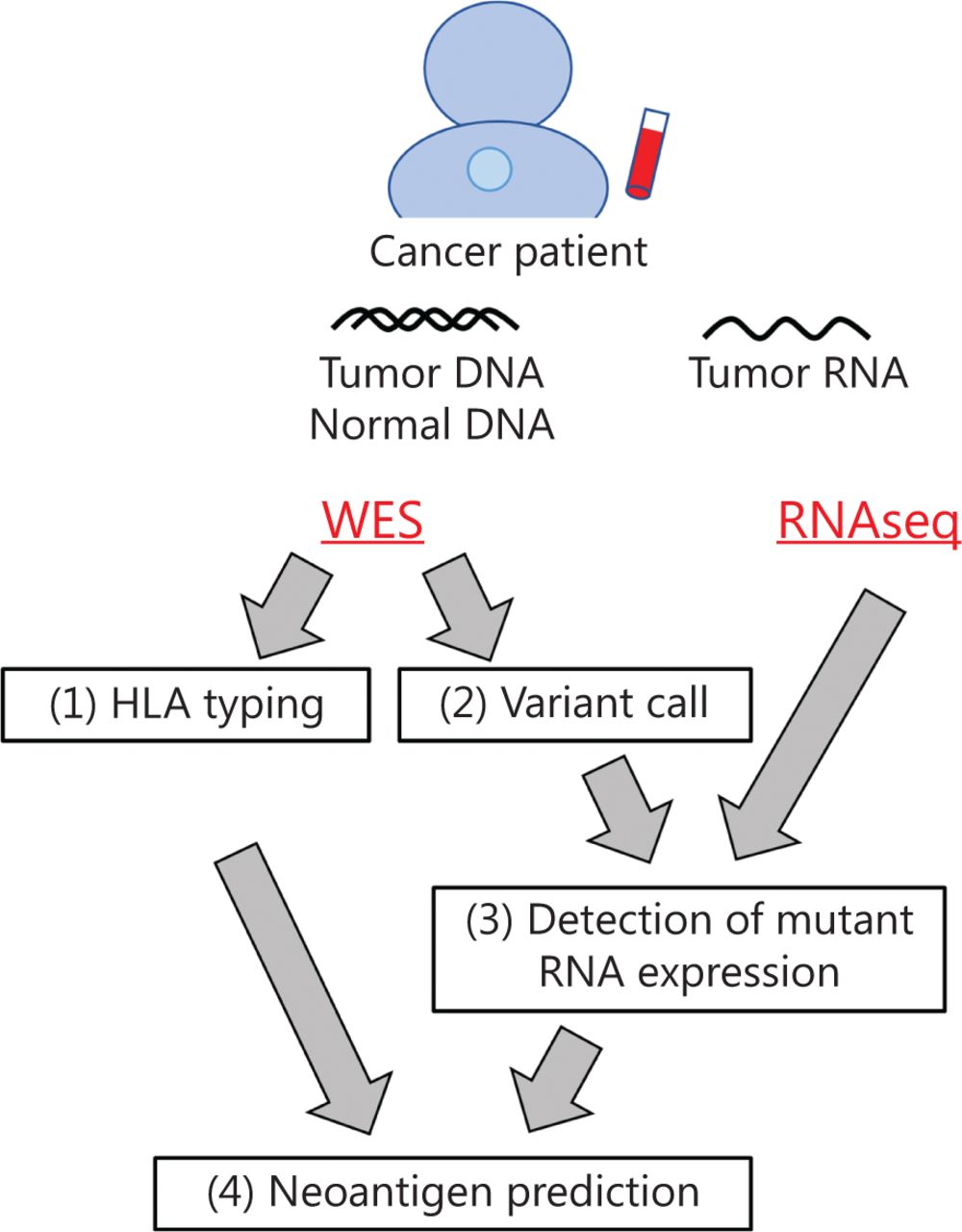
    Figure 2

    Workflow of neoantigen prediction pipeline from genome sequencing data. The first step is HLA class I genotyping (at 2-field level) based on WES data. The second and third steps are somatic variant call and detection of mutant RNA expression. Non-synonymous SNVs and indels, which alter amino acid sequences, were selected and further analyzed. The last step is binding affinity prediction of mutated peptides to individuals’ HLA molecules. WES, whole-exome sequencing; RNAseq, RNA sequencing; SNVs, single nucleotide variations; Indels, insertions/deletions.

Tables

  • Figures
    • View popup
    Table 1

    Selected clinical trials of genotype-based therapy

    InstituteYearSample sizePlatformTissue samplePatients with actionable mutationsPatients enrolled in genotype-matched trialsORR of patients matched to treatment based on genotype
    MD Anderson Cancer Center520152,00011–50 gene panelsFFPE789/2,000 (39.5%)83/2,000 (4.2%)Not available
    Memorial Sloan Kettering Cancer Center2201612,670341 or 410 gene panelsFFPE3,792/10,336 (36.7%)527/5,009 (10.5%)Not available
    Dana-Farber/Harvard Cancer Center620163,727275 gene panelsFFPE31/50 (62.0%)16/50 (32.0%)Not available
    Princess Margaret Cancer Centre420161,64023–48 gene panelsFFPE25%84/1,640 (5.1%)19%
    Gustave Roussy8820171,03530–75 gene panels + aCGHFF411/1,035 (39.7%)199/1,035 (19.2%)11%
    University of Michigan892017556WGS, WES, RNAseqFFNot available3%–11%Not available
    Lyon9020192,57969 gene panels + aCGHFFPE699/2,579 (27.1%)182/2,579 (7.1%)13%

    aCGH, array conparative genomic hybridization; WGS, whole-genome sequencing; WES, whole-exome sequencing; FFPE, formalin-fixed paraffin-embedded; FF, fresh-frozen; ORR, objective response rate.

      • View popup
      Table 2

      Published clinical trials of personalized neoantigen vaccines

      InstituteYearCancer typeVaccine typePatient numberClinical responseOther clinical response information
      CRPRSDPD
      Washington University School of Medicine912015MelanomaDendritic cell vaccine31020–
      BioNTech772017MelanomaRNA vaccine13–––58 recurrent-free 12–23 months2 CR, 1 PR, 1 SD for relapses in combination with ICIs
      Dana-Farber/Harvard Cancer Center782017MelanomaLong peptide vaccine + Poly-ICLC6–––24 recurrent-free 20–32 months2 CR for relapses in combination with ICIs
      Dana-Farber/Harvard Cancer Center792019GlioblastomaLong peptide vaccine + Poly-ICLC80008PFS 7.6 months, OS 16.8 months
      Immatics Biotechnologies, BioNTech802019GlioblastomaLong/short peptide vaccine + Poly-ICLC + GM-CSF1502211PFS 14.2 months, OS 29.0 months
      Dana-Farber/Harvard Cancer Center, BioNTech812020MelanomaLong peptide vaccine + Poly-ICLC2711574PFS 23.5 months
      NSCLC180792PFS 8.5 months
      Bladder cancer151392PFS 5.8 months

      NSCLC, non-small cell lung cancer; Poly-ICLC, polyinosinic-polycytidylic acid-poly-l-lysine carboxymethylcellulose; GM-CSF, granulocyte macrophage colony-stimulating factor; CR, complete response; PR, partial response; SD, stable disease; PD, progressive disease; PFS, progression-free survival; OS, overall survival; ICIs, immune checkpoint inhibitors.

      PreviousNext
      Back to top

      In this issue

      Cancer Biology & Medicine: 18 (4)
      Cancer Biology & Medicine
      Vol. 18, Issue 4
      1 Nov 2021
      • Table of Contents
      • Index by author
      Print
      Download PDF
      Email Article

      Thank you for your interest in spreading the word on Cancer Biology & Medicine.

      NOTE: We only request your email address so that the person you are recommending the page to knows that you wanted them to see it, and that it is not junk mail. We do not capture any email address.

      Enter multiple addresses on separate lines or separate them with commas.
      Personalized immunotherapy in cancer precision medicine
      (Your Name) has sent you a message from Cancer Biology & Medicine
      (Your Name) thought you would like to see the Cancer Biology & Medicine web site.
      Citation Tools
      Personalized immunotherapy in cancer precision medicine
      Kazuma Kiyotani, Yujiro Toyoshima, Yusuke Nakamura
      Cancer Biology & Medicine Nov 2021, 18 (4) 955-965; DOI: 10.20892/j.issn.2095-3941.2021.0032

      Citation Manager Formats

      • BibTeX
      • Bookends
      • EasyBib
      • EndNote (tagged)
      • EndNote 8 (xml)
      • Medlars
      • Mendeley
      • Papers
      • RefWorks Tagged
      • Ref Manager
      • RIS
      • Zotero
      Share
      Personalized immunotherapy in cancer precision medicine
      Kazuma Kiyotani, Yujiro Toyoshima, Yusuke Nakamura
      Cancer Biology & Medicine Nov 2021, 18 (4) 955-965; DOI: 10.20892/j.issn.2095-3941.2021.0032
      Twitter logo Facebook logo Mendeley logo
      • Tweet Widget
      • Facebook Like
      • Google Plus One

      Jump to section

      • Article
        • Abstract
        • Introduction
        • Somatic mutation-based selection of molecular-targeted drugs
        • Immune checkpoint inhibitors
        • Neoantigens
        • Personalized immunotherapy targeting cancer-specific neoantigens
        • Conclusions
        • Grant support
        • Footnotes
        • References
      • Figures & Data
      • Info & Metrics
      • References
      • PDF

      Related Articles

      • No related articles found.
      • Google Scholar

      Cited By...

      • Neoantigen cancer vaccines: a new star on the horizon
      • Peptide drugs: a new direction in cancer immunotherapy
      • DNA methylation profiles in cancer: functions, therapy, and beyond
      • Using triple radio-immunotherapy to overcome cancer immunotherapy resistance
      • Repurposing drugs for solid tumor treatment: focus on immune checkpoint inhibitors
      • Preclinical and clinical trials of oncolytic vaccinia virus in cancer immunotherapy: a comprehensive review
      • Potential new applications of immunotherapy for neuroendocrine neoplasms: immune landscape, current status and future perspectives
      • The advanced development of molecular targeted therapy for hepatocellular carcinoma
      • Google Scholar

      More in this TOC Section

      • Gut microecology empowers cancer immunotherapy: commensal microbiota-mediated mechanisms and translational prospects of PD-1/PD-L1 therapy
      • Innovative cross-intervention: copper ions and metabolic pathways in cancer therapy
      • From residual risk to precision intervention: the evolving role of minimal residual disease in breast cancer management
      Show more Review

      Similar Articles

      Keywords

      • personalized medicine
      • cancer precision medicine
      • Neoantigen
      • personalized immunotherapy
      • immune checkpoint blockade
      • cancer vaccine
      • adoptive T cell therapy

      Navigate

      • Home
      • Current Issue

      More Information

      • About CBM
      • About CACA
      • About TMUCIH
      • Editorial Board
      • Subscription

      For Authors

      • Instructions for authors
      • Journal Policies
      • Submit a Manuscript

      Journal Services

      • Email Alerts
      • Facebook
      • RSS Feeds
      • Twitter


      © 2026 Cancer Biology & Medicine

      Powered by HighWire