

Main menu

  • Home
  • About
    • About CBM
    • Editorial Board
    • Announcement
  • Articles
    • Ahead of print
    • Current Issue
    • Archive
    • Collections
    • Cover Story
  • For Authors
    • Instructions for Authors
    • Resources
    • Submit a Manuscript
  • For Reviewers
    • Become a Reviewer
    • Instructions for Reviewers
    • Resources
    • Outstanding Reviewer
  • Subscription
  • Alerts
    • Email Alerts
    • RSS Feeds
    • Table of Contents
  • Contact us
  • Other Publications
    • cbm

User menu

  • My alerts

Search

  • Advanced search
Cancer Biology & Medicine
  • Other Publications
    • cbm
  • My alerts
Cancer Biology & Medicine

Advanced Search


  • Home
  • About
    • About CBM
    • Editorial Board
    • Announcement
  • Articles
    • Ahead of print
    • Current Issue
    • Archive
    • Collections
    • Cover Story
  • For Authors
    • Instructions for Authors
    • Resources
    • Submit a Manuscript
  • For Reviewers
    • Become a Reviewer
    • Instructions for Reviewers
    • Resources
    • Outstanding Reviewer
  • Subscription
  • Alerts
    • Email Alerts
    • RSS Feeds
    • Table of Contents
  • Contact us
  • Follow cbm on Twitter
  • Visit cbm on Facebook
Review ArticleReview

Quantum Dots for Cancer Research: Current Status, Remaining Issues, and Future Perspectives

Min Fang, Chun-wei Peng, Dai-Wen Pang and Yan Li
Cancer Biology & Medicine September 2012, 9 (3) 151-163; DOI: https://doi.org/10.7497/j.issn.2095-3941.2012.03.001
Min Fang
1Department of Oncology, Zhongnan Hospital of Wuhan University, Hubei Key Laboratory of Tumor Biological Behaviors & Hubei Cancer Clinical Study Center, Wuhan 430071, China
  • Find this author on Google Scholar
  • Find this author on PubMed
  • Search for this author on this site
Chun-wei Peng
1Department of Oncology, Zhongnan Hospital of Wuhan University, Hubei Key Laboratory of Tumor Biological Behaviors & Hubei Cancer Clinical Study Center, Wuhan 430071, China
  • Find this author on Google Scholar
  • Find this author on PubMed
  • Search for this author on this site
Dai-Wen Pang
2Key Laboratory of Analytical Chemistry for Biology and Medicine (Ministry of Education), College of Chemistry and Molecular Sciences, and State Key Laboratory of Virology, Wuhan University, Wuhan 430072, China
  • Find this author on Google Scholar
  • Find this author on PubMed
  • Search for this author on this site
Yan Li
1Department of Oncology, Zhongnan Hospital of Wuhan University, Hubei Key Laboratory of Tumor Biological Behaviors & Hubei Cancer Clinical Study Center, Wuhan 430071, China
  • Find this author on Google Scholar
  • Find this author on PubMed
  • Search for this author on this site
  • For correspondence: liyansd2{at}163.com
  • Article
  • Figures & Data
  • Info & Metrics
  • References
  • PDF
Loading

Article Figures & Data

Figures

  • Tables
  • 1
    • Download figure
    • Open in new tab
    • Download powerpoint
    1

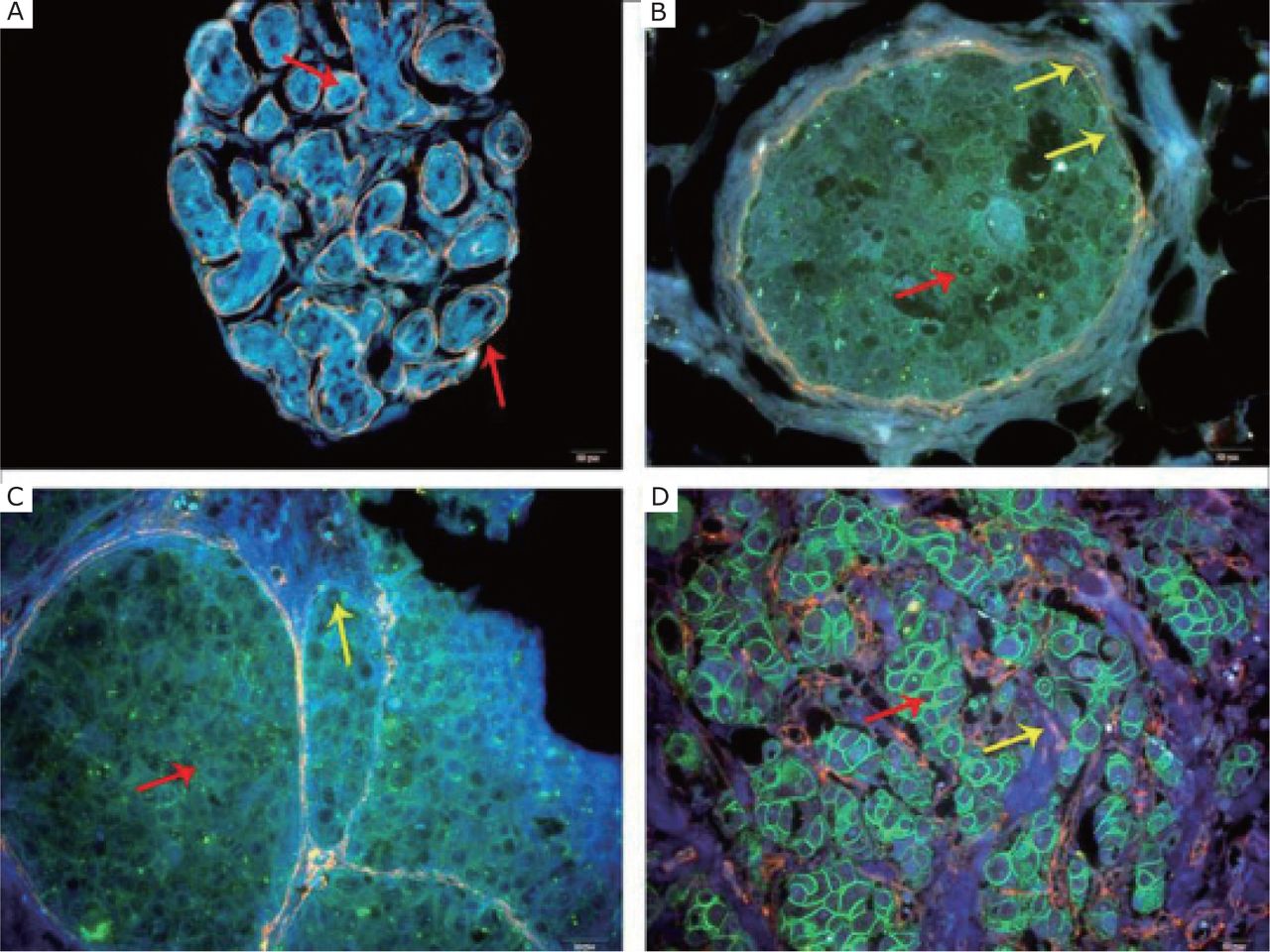
    Accurate HER2 testing by QD–IHC. A: Specimens with different HER2 IHC scores detected by QD–IHC. B: Control for (A) by conventional IHC. C: FISH positive. D: Negative. Scale bar: 100 µm for (A) and (B); 20 µm for (C) and (D). Reproduced with permission from [55].

  • 2
    • Download figure
    • Open in new tab
    • Download powerpoint
    2

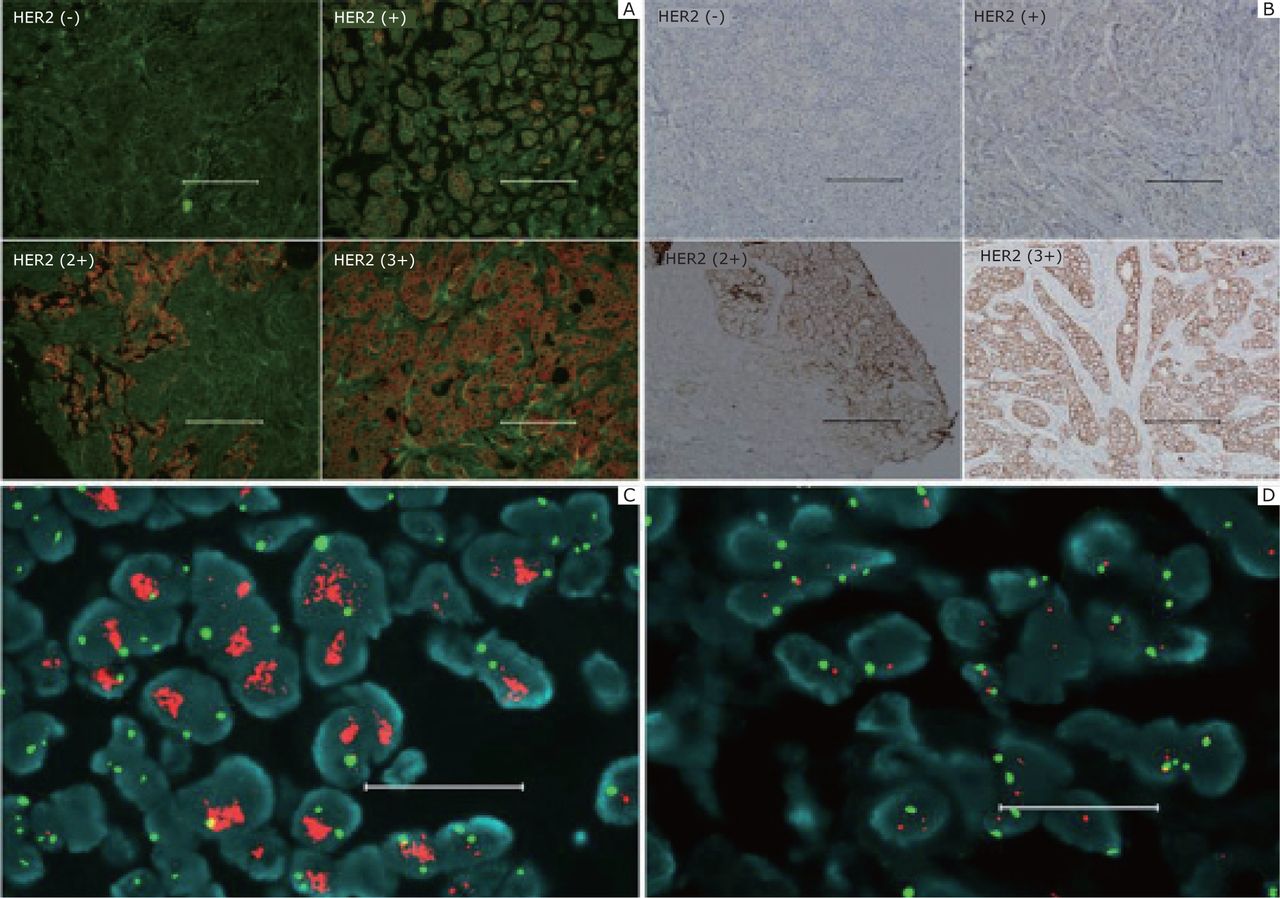
    In vivo targeting and imaging of a lung metastasis model with QD-based nanotechnology. A: The imaging system for living animal models. B: In vivo targeted imaging of the subcutaneous tumor model and site-by-site spectra analysis of the tumor, which showed that the QD-labeled anti-a-fetoprotein monoclonal antibody probes per field were lower at the center than in the periphery of the tumor, indicating that tumor growth was not homogeneous and the peripheral site was more active. C: In vivo targeted imaging of liver cancer lung metastasis models. Reproduced with permission from [53].

  • 3
    • Download figure
    • Open in new tab
    • Download powerpoint
    3

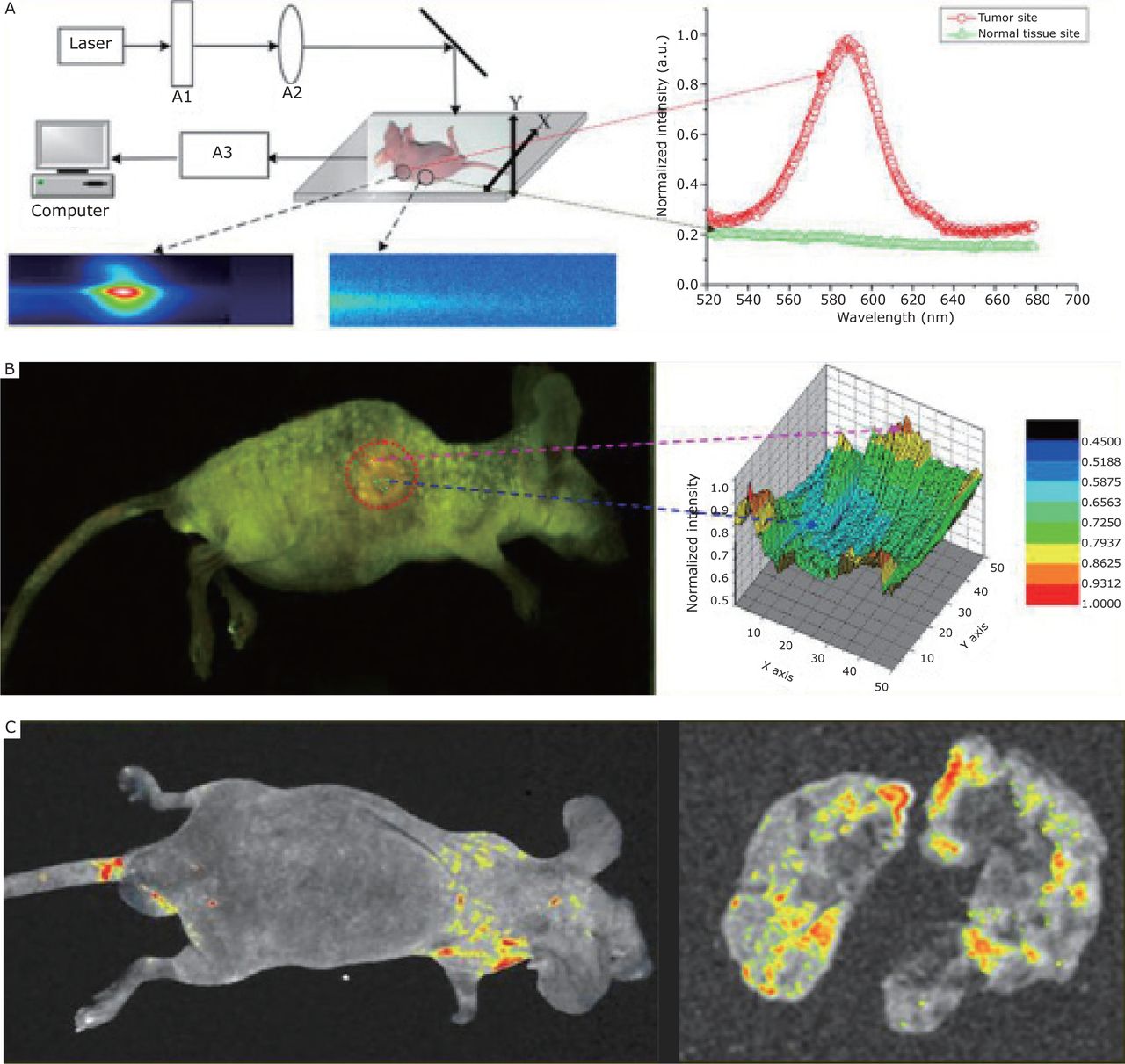
    The establishment of multiplexed QD imaging and spectrum analysis. A1, B1, and C1: Infiltrating macrophages (Green arrows), type IV collagen (Yellow arrows), and neovessels (Red arrows) are labeled simultaneously in gastric cancer tissues with nanoprobes QDs-525, QDs-585, and QDs-655, respectively. A2, B2, and C2: Corresponding unmixed image of A1, B1, and C1 obtained by spectrum analysis with differentiable autofluorescence (Blue arrows). D: QD emission spectra and tissue autofluorescence data used for unmixed image. Magnification: ×100 (A1 and A2), ×200 (B1 and B2), and ×400 (C1 and C2); Scale bar: 100 mm (A1 and A2), 50 mm (B1 and B2), and 20 mm (C1 and C2). Reproduced with permission from [103].

  • 4
    • Download figure
    • Open in new tab
    • Download powerpoint
    4

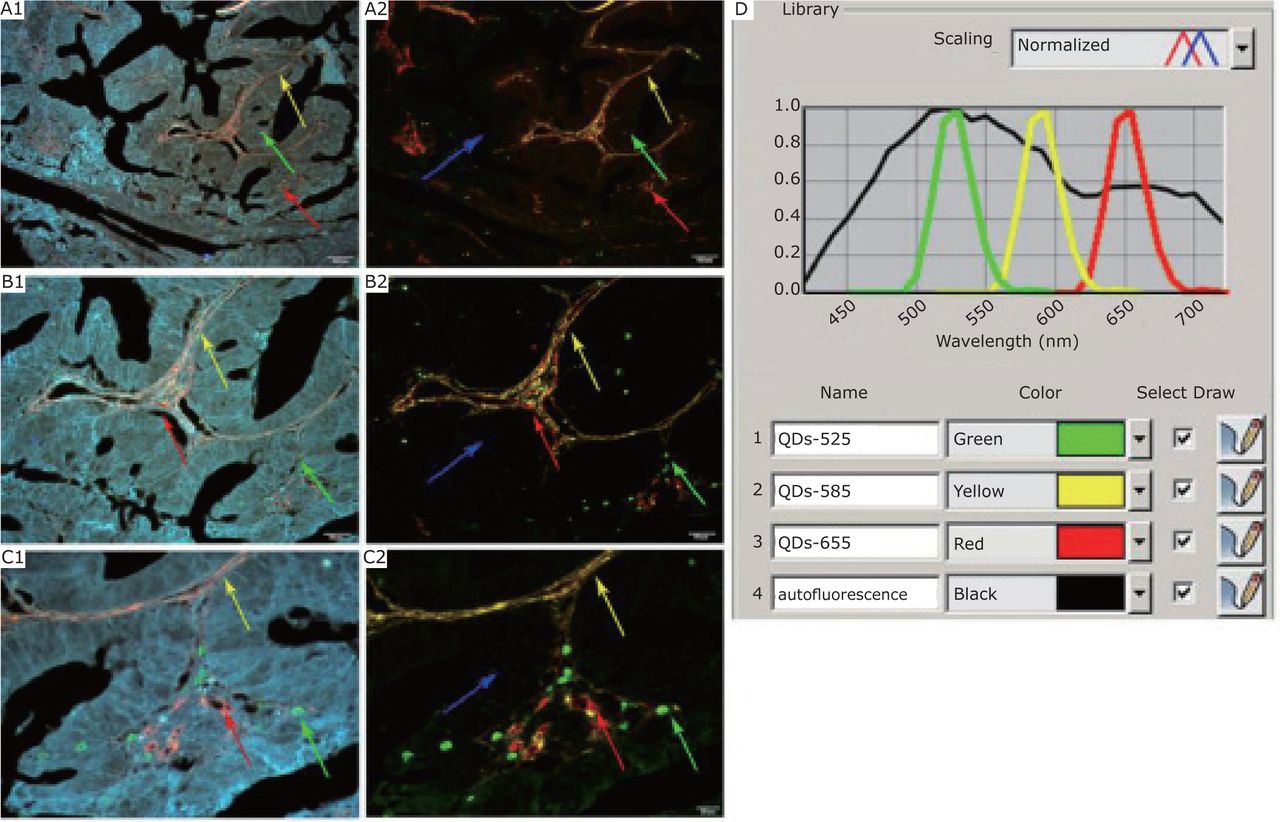
    Double-color imaging was used in BC over different levels of HER2. A: Benign breast tumor, no HER2 expression, and intact ECM (Red arrow). B: BC with HER2 (+) (Red arrow), ECM becomes unsmooth and thin (Yellow arrows). C: HER2 (2+) and moderate green fluorescence (Red arrow). ECM becomes significantly degraded (Yellow arrow). D: HER2 (3+), strong green fluorescence (Red arrow) and complete ECM degradation (Yellow arrow). (Magnification: ×, scale bar =20 µm). Reproduced with permission from [69].
Tables

  • Figures
    • View popup
    1

    Comparison of the characteristics and applications between traditional organic fluorophores and QDs.

    PropertyTraditional organic fluorophores[32–35]Quantum dots[29, 36–42]
    Chemical propertiesChemical resistance is often poorResistant to chemical degradation; sensitivity to pH determined by coatings
    Size scaleMolecular, <0.5 nmColloidal, 1.5 nm to 10 nm diameter
    Hydrodynamic radiusSmall, <0.6 nmaVariable, 1.4 nm to 40 nmb
    Absorption spectraDiscrete bands, FWHMc, 35 nmd to 80 nm to 100 nmeStrong and broad
    Emission spectraBroad, red-tailed, and asymmetric, FWHM, 35 nm to 70 nm to100 nmNarrow, symmetric, FWHM, 30 nm to 90 nm
    Two-photon cross-section10 GM to 500 GM(2,000 to 47,700) GMf
    Molar absorption coefficient(103 to 105) cm-1mol-1L(105 to 106) cm-1mol-1L
    Quantum yieldVariable, 0.05 to 1.0High, >20%g
    Fluorescence lifetimeShort, <5 ns, mono-exponential decayLong, >10 ns, typically multi-exponential decay
    Solubility or dispersibilityControl by substitution patternControl via surface chemistry (ligands)
    Thermal stabilityDependent on dye class; can be critical for NIR-wavelength dyesHigh; depends on shell or ligands
    PhotostabilityUsually poorExcellent resistance to photobleaching; observation time of minutes to hours
    Bioconjugation labelsMonovalent to multivalent labeling possibleScaffolds; Monovalent conjugation can be challenging; distribution of multivalences often encountered
    Applicability to single molecule analysisModerate; limited by photobleachingGood; limited by blinking
    Spectral MultiplexingPossibleIdeal for multi-color experiments; up to five colors demonstrated
    MultifunctionalityDifficult and fewGreat potential
    ToxicityVariable, based on dyeRelated to the heavy metal

    a:Except for fluorescent proteins, GFP 4.6×2.4 nm cylindrical shape

    b:Coating, ligand, and bioconjugate-dependent

    c:FWHM, full width at half height of the maximum.

    d:Dyes with resonant emission, such as fluoresceins, rhodamines and cyanines.

    e:CT dyes.

    f:Wavelength-dependent; GM: Goeppert–Mayer units

    g:Ligand, coating and solvent-dependent

      • View popup
      2

      Applications of QD-based multimodality imaging for tumor.

      ProbesModalitySize (nm)ApplicationReferences
      64Cu-DOTA to CdTe/ZnS (QD705)PET/opticalNDTumor vasculature imaging[100,122,123]
      64Cu-DOTA to CdSe/ZnS (QD525, QD800)PET/opticalNDQuantitative biodistribution in living mice[124]
      Gd-DOTA to CdSeTe/CdS/glutathioneMRI/optical7 to 10Lymph node imaging of mouse[125]
      Iron oxide and CdSe/ZnS micelleMRI/optical6.7Simultaneous targeted drug delivery and dual-mode imaging of tumor tissues by near-infrared fluorescence and NMR spectroscopy[126]
      Resolve Al-Gd and CdSe/ZnS micelleMRI/optical18Tracing blood circulation in vivo[127]
      Gd-lipid in coating and CdSe/ZnS/silicaMRI/optical15Tumor angiogenesis imaging[115]
      MnCdTeSe/CdSMRI/optical4 to 50Pancreatic cancer imaging[128]
    PreviousNext
    Back to top

    In this issue

    Cancer Biology and Medicine: 9 (3)
    Cancer Biology & Medicine
    Vol. 9, Issue 3
    1 Sep 2012
    • Table of Contents
    • Index by author
    Print
    Download PDF
    Email Article

    Thank you for your interest in spreading the word on Cancer Biology & Medicine.

    NOTE: We only request your email address so that the person you are recommending the page to knows that you wanted them to see it, and that it is not junk mail. We do not capture any email address.

    Enter multiple addresses on separate lines or separate them with commas.
    Quantum Dots for Cancer Research: Current Status, Remaining Issues, and Future Perspectives
    (Your Name) has sent you a message from Cancer Biology & Medicine
    (Your Name) thought you would like to see the Cancer Biology & Medicine web site.
    Citation Tools
    Quantum Dots for Cancer Research: Current Status, Remaining Issues, and Future Perspectives
    Min Fang, Chun-wei Peng, Dai-Wen Pang, Yan Li
    Cancer Biology & Medicine Sep 2012, 9 (3) 151-163; DOI: 10.7497/j.issn.2095-3941.2012.03.001

    Citation Manager Formats

    • BibTeX
    • Bookends
    • EasyBib
    • EndNote (tagged)
    • EndNote 8 (xml)
    • Medlars
    • Mendeley
    • Papers
    • RefWorks Tagged
    • Ref Manager
    • RIS
    • Zotero
    Share
    Quantum Dots for Cancer Research: Current Status, Remaining Issues, and Future Perspectives
    Min Fang, Chun-wei Peng, Dai-Wen Pang, Yan Li
    Cancer Biology & Medicine Sep 2012, 9 (3) 151-163; DOI: 10.7497/j.issn.2095-3941.2012.03.001
    Twitter logo Facebook logo Mendeley logo
    • Tweet Widget
    • Facebook Like
    • Google Plus One

    Jump to section

    • Article
      • Abstract
      • Introduction
      • Characteristics of QDs for Biomedical Application
      • Application of QD-based Nanotechnology for Cancer Research
      • Application of QD-based Multimodality Biomedical Molecular imaging
      • Challenges and Future Prospects
      • Conclusions
      • Acknowledgements
      • Footnotes
      • References
    • Figures & Data
    • Info & Metrics
    • References
    • PDF

    Related Articles

    • No related articles found.
    • Google Scholar

    Cited By...

    • No citing articles found.
    • Google Scholar

    More in this TOC Section

    • Harnessing the power of cancer-associated fibroblasts to revolutionize pancreatic cancer treatment
    • From residual risk to precision intervention: the evolving role of minimal residual disease in breast cancer management
    • Primary cilia in cancer: structures, functions, mechanisms, and therapeutic implications
    Show more Review

    Similar Articles

    Keywords

    • quantum dots
    • molecular imaging
    • multimodality probes

    Navigate

    • Home
    • Current Issue

    More Information

    • About CBM
    • About CACA
    • About TMUCIH
    • Editorial Board
    • Subscription

    For Authors

    • Instructions for authors
    • Journal Policies
    • Submit a Manuscript

    Journal Services

    • Email Alerts
    • Facebook
    • RSS Feeds
    • Twitter


    © 2025 Cancer Biology & Medicine

    Powered by HighWire