





Abstract
OBJECTIVE To study the mechanism of IFN on CML.
METHODS Samples of 15 CML patients and 10 healthy controls were studied. The flow cytometry was performed to identify circulating pDCs. The concentration of IFN-α in serum and that in the supernatant of peripheral blood mononuclear cells (PBMCs) cultured after stimulation with CpG ODN2216 were examined both in CML patients and in the healthy controls
RESULTS There was significant reduction in the number of circulating pDCs, serum concentration of IFN-α and the capacity of IFN-α producing PBMCs in CML patients compared with those in healthy control individuals (P < 0.001). After the active treatment with IFN-α and hydroxyurea, the quantity and function of pDCs were increased in stabilized patients, especially the function of pDCs in 2 patients achieving major cytogenetic response (MCR). The proportion and function of pDCs and the serum levels of IFN were inversely correlated with both WBC and age of the patients with CML, and positively correlated with the state of the illness.
CONCLUSION CML patients had a reduced number and dysfunction of circulating pDCs. The active treatment with IFN in CML patients may be related to the restoration of pDCs.
keywords
Introduction
Chronic myeloid leukemia (CML) is a hematopoietic stem cell disorder[1] characterized by the presence of the Philadelphia chromosome (Ph+), in which interferon-alpha (IFN-α) has demonstrated substantial activity. There are both clinical and laboratory evidence[2,3] suggesting that BCR/ABL tyrosine kinase inhibitor (imatinib mesylate) therapy alone is not curative in CML, whereas IFN has induced a low but reproducible curative effect in some patients. As professional cells[4] producing type 1 interferon, the plasmacytoid dendritic cell precursors (pDCs) have shown a significant changes[5-7] not only in diseases of viral and bacterial infection (HIV, HCV, TB), auto-immunolgic diseases, but also in cancer. Here, we investigated whether the patients with CML-CP responded to IFN-α is related to pDC.
Materials and Methods
Patients and controls
Samples were obtained from both 15 CML patients in chronic phase (CP) (9 males and 6 females; age 44.2 ± 10.50 years, 100% Ph1-positive) at diagnosis and 10 healthy control individuals (5 males and 5 females; age 42.7 ± 9.92 years) after informed consents were confirmed. All patients had been treated with IFN-α (3 million units IH qod) in combination with hydroxyurea (0.5-2.0 g/day orally) for 1 year. All cytogenetic studies were performed every 3 months during the first 12 months of treatment on bone marrow specimens. At least 20 metaphases were analyzed for a study which is considered evaluable for cytogenetic response which was categorized as complete (no Ph chromosome-positive cells in metaphase in the bone marrow), partial (1%-34% Ph chromosome-positive cells), or minor (35%-90% Ph chromosome-positive cells). Major cytogenetic responses (MCR) included complete and partial cytogenetic responses. PBMCs were prepared using Ficoll-Hypaque density gradient centrifugation prior to cryopreservation. Cells were washed and suspended in RPMI 1640 medium containing penicillin (100 U/ml), streptomycin (100 μg/ml) and 10% fetal bovine serum that had been inactivated by heating pDCs at 56°C for 1 h.
Flow cytometry
Dzionek et al.[8] identified a novel marker for pDCs, the blood dendritic cell antigen (BDCA-2) which enables direct identification of pDCs in blood. In this study, we investigated the populations of plasmacytoid DC (BDCA-2+) in the peripheral blood of CML patients and healthy individuals using flow cytometry after staining with anti-BDCA-2-fluorescein isothiocyanate (FITC) monoclonal antibody (Mouse IgG1; United States eBioscience) at 4°C for 30 min, and the isotype control experiments were conducted in parallel. After two washes, the cells were resuspended in phosphate-buffered saline (PBS) and analyzed by flow cytometry. pDCs were identified by staining for BDCA-2. Stained cells were analyzed on a FACSC cytometer using Cell Quest software.
Measurement of IFN-α
PBMCs (1 × 10⁶ cells) were stimulated using 1 μmol/L CpG-ODN2216 in a final volume of 500 μl/well in 48-well plates for 24 h. Supernatant was collected from cultured cells and the sera were stored at -80°C for further use. The IFN-α in the sera and supernatant were then measured using a sensitive sandwich ELISA kit. All measurements were performed in duplicate and average values were used in the data analysis.
Statistical analysis
All analyses were performed using SPSS (version 11.0). Data were expressed as the mean ± SD deviation. A level of P < 0.05 was considered as statistically significant.
Results
The numbers of pDCs
The median frequency of pDCs (BDCA-2+) in blood were decreased in newly diagnosed CML patients (0.153 ± 0.037)% compared with that in healthy controls (0.291 ± 0.050)%, P < 0.001, especially in the 3 aged people (0.093 ± 0.006)% with higher WBC. After 1-year IFN-α and hydroxyurea treatment, there was an increasing number (0.196 ± 0.049)% of pDCs shown in 12 stabilized patients, whereas 3 patients without response to the treatment had lower frequency (0.043±0.025)% of pDCs.
The function of pDCs
Because the number of circulating pDCs is very low among total PBMCs, therefore, it is difficult to isolate this type of cells from a blood sample and the pDC is a main type 1 interferon producing cells in PBMCs[4]. The function of pDCs (IFN-α inducing production) was measured in total PBMCs using a pDC-specific TLR9 ligand (CpG-ODN2216) as stimulators[9]. Consistent with a decreased number of circulating pDCs in CML, PBMC in CML (476.95 ± 57.08) pg/ml produced less IFN-α than that in control donors did (985.93 ± 30.43) pg/ml when stimulated in vitro with ODN-2216 (P < 0.001). After 1-year continuous treatment with IFN-α and hydroxyurea, the capacity of IFN-α producing PBMCs was prominently higher in patients who had response to the treatment (915.21 ± 32.68) pg/ml than that of the patients before the treatment (P < 0.001), especially 2 of the patients achieving the level of MCR slightly higher [(991.10 ± 2.69) pg/ml, P = 0.884] than that of the normal individuals. Whereas 3 progressive patients had significantly low IFN-α production (108.57 ± 15.85) pg/ml.
The amounts of IFN-α in the sera
Comparing serum concentration of IFN-α in CML patients with that in healthy control individuals (133.30 ± 23.32) pg/ml, the levels of IFN-α in newly diagnosed CML patients were significantly lower [(76.07 ± 3.13) pg/ml, P < 0.001]. After 1-year treatment, the serum levels of IFN in 12 stabilized patients were significantly increased (107.78 ± 13.95) pg/ml, especially 2 of them achieving the level of MCR near that [(130.35 ± 1.20) pg/ml, P = 0.774] of healthy controls, and the serum levels of IFN in 3 progressive patients were decreased (34.13 ± 7.22) pg/ml.
Correlation analysis
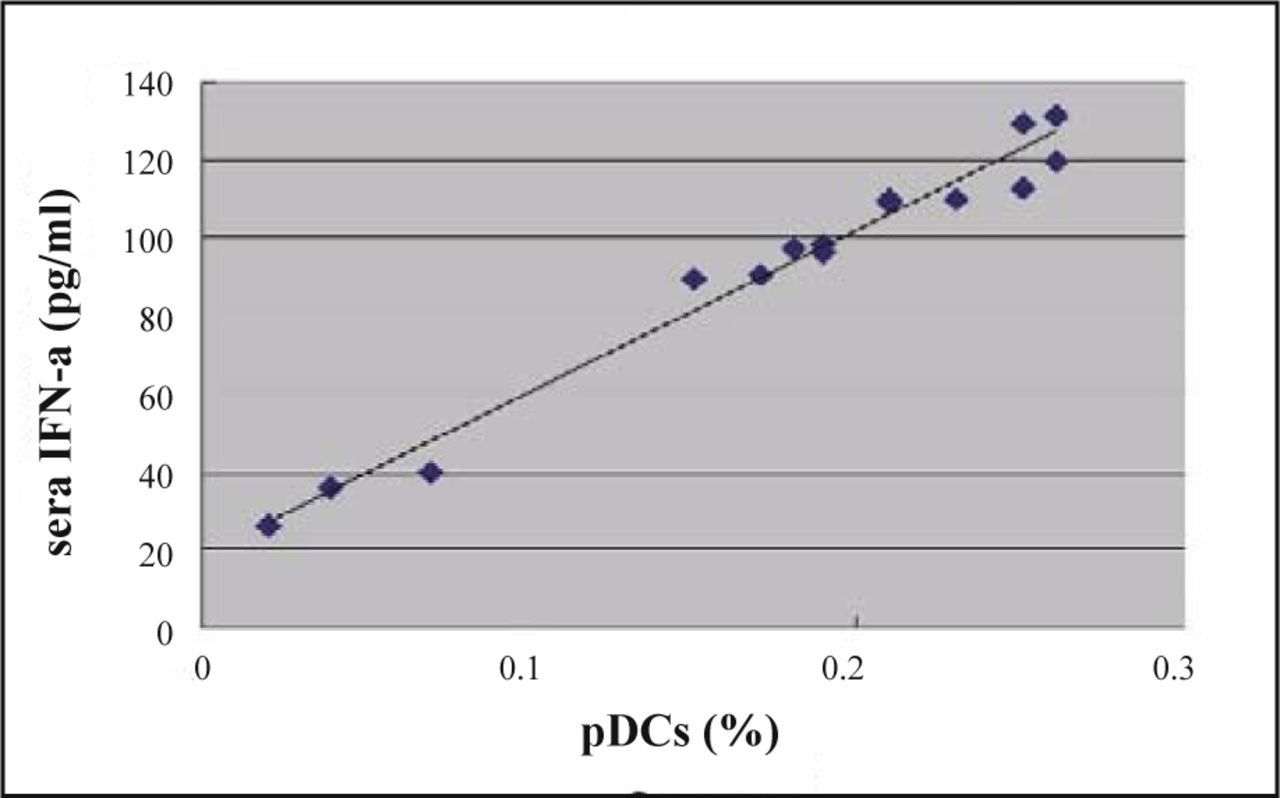
The proportion and function of pDCs and the serum levels of IFN are inversely correlated with both WBC and age of patients with CML, and positively correlated with the state of the illness (Fig. 1, 2). There was no correlation with sex. Interestingly, regardless the influence of the number of pDCs, the function of pDCs was directly correlated with the levels of IFN in sera (r = 0.604, P = 0.022) in post-treatment patients, and not significantly correlated (r = 0.181, P = 0.535) with those in new diagnosed patients.
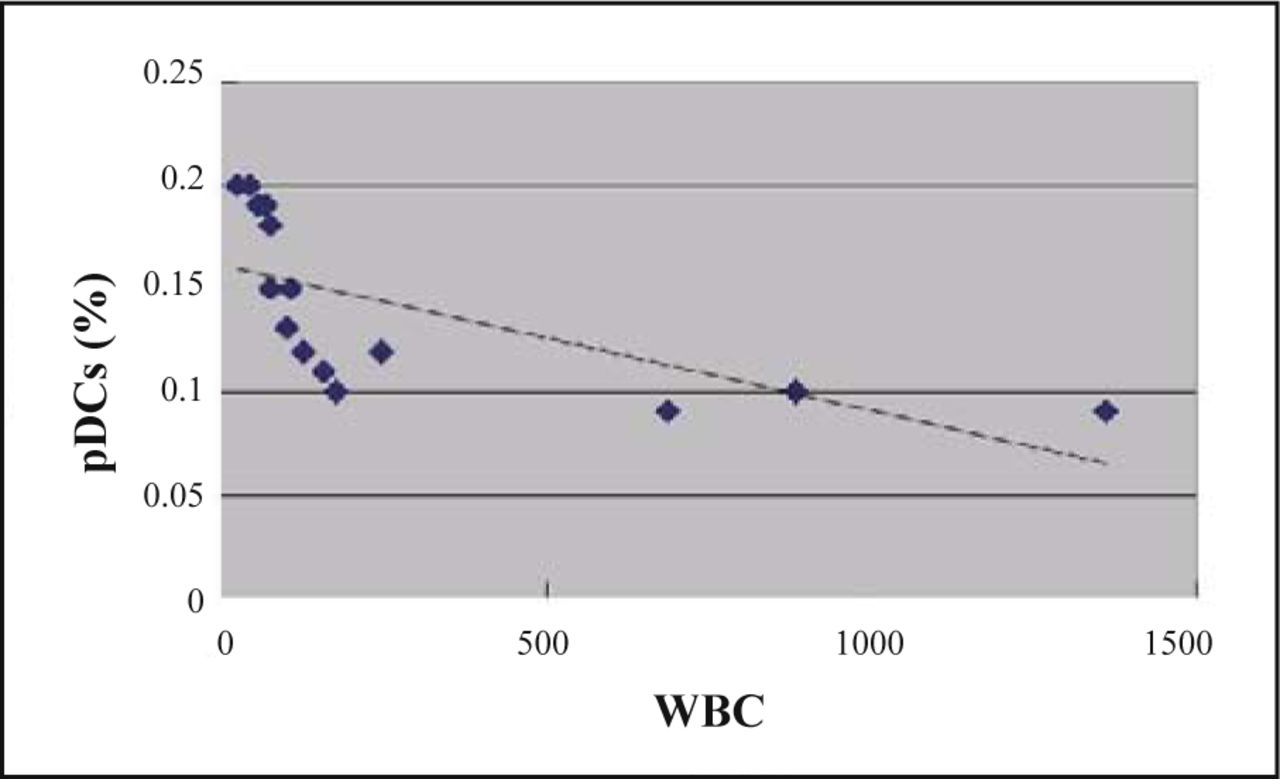
Correlation with WBC and pDCs% in new CML (r = -0.666, P = 0.007)
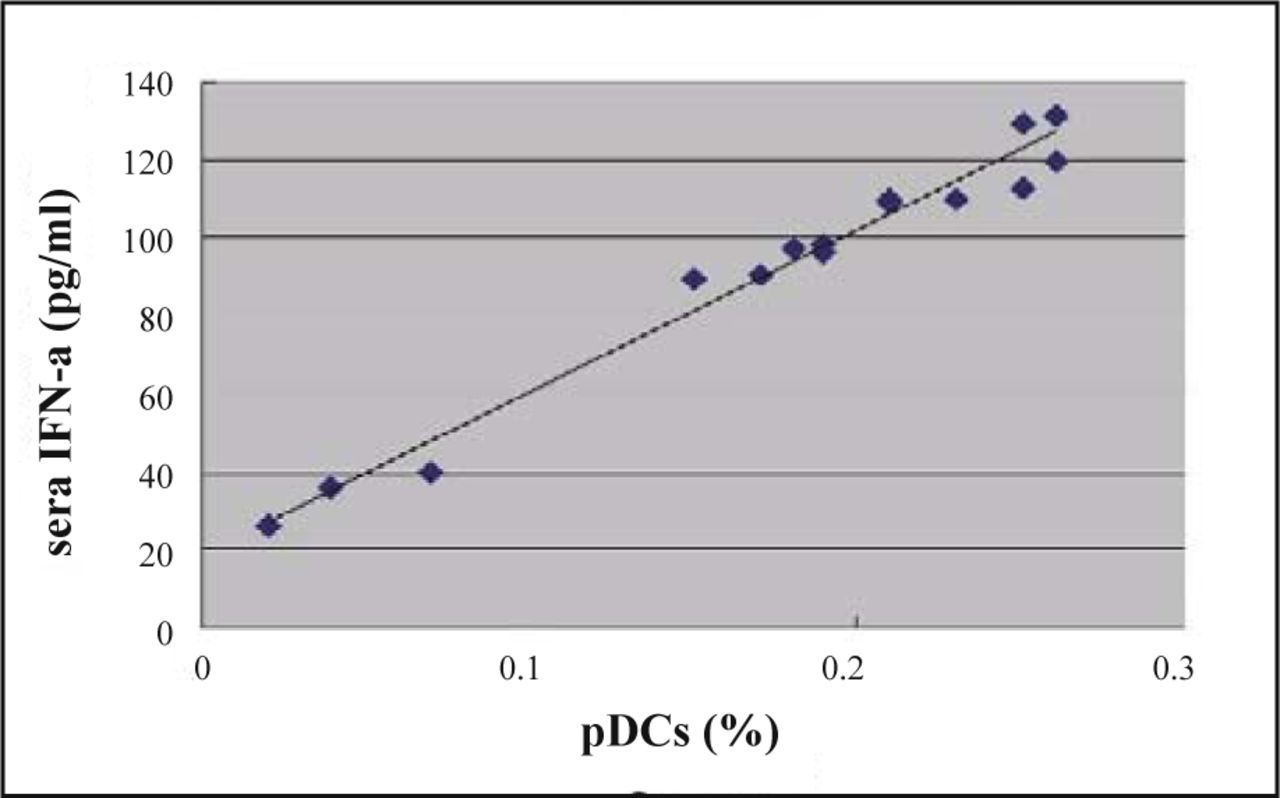
Correlation with pDCs% and sera IFN-a in post-treatment CML (r = 0.986, P < 0.001)
Discussion
Chronic myeloid leukaemia[1] is a clonal disease of stem cell origin characterized by Ph+ and its fusion gene product, Bcr-Abl, a constitutively active tyrosine kinase. This oncogenic event is central to the pathogenesis of CML, allowing for the malignant clone to expand, suppress and replace normal hematopoiesis.
The allogeneic hematopoietic stem cell transplantation (Allo-HSCT) was the only known curative treatment to eradicate Ph+[2,3,10-12], but the mortality associated with the procedure of the treatment and the lack of available donor excluded it as a viable option for many patients. Imatinib, the first-line therapy for CML, single-agent has not shown curative effects as Bcr-Abl+ progenitors were constantly present despite continuous therapy. Interferon-a based therapy for early diagnosed CML patients in chronic phase had achieved a 27% of complete cytogenetic response (CCyR) within a median time of 16 months, and experienced a long-term survival. Furthermore, a small subset of patients was able to achieve a durable cytogenetic remission both on and off interferon-a based therapy. These findings suggest interferon-a may be a potentially curative way for some patients.
As professional interferon produces cells, pDCs[4,13] represent 0.2%-0.8% of PBMCs in both human and mouse, expressing Toll-like receptor (TLR7 and TLR9), and are crucial effectors in innate and adaptive immune responses. Several studies[5-7] have revealed that pDC number may be altered in the course of different diseases. In this study, we also found a decreased number of pDCs among 15 newly diagnosed CML-CP patients (0.153 ± 0.037)% compared with that in healthy controls [(0.291 ± 0.050)%, P < 0.001], especially in 3 aged patients with higher WBC counts (0.093 ± 0.006)%. Consistent with a decreased number of circulating pDCs, their functions (476.95 ± 57.08) pg/ml and serum concentration of IFN-α (76.07 ± 3.13) pg/ml were also impaired and decreased in the CML patients than those in the controls (P < 0.001). Correlation analysis indicated that the proportion and function of pDCs and the IFN levels in sera were inversely correlated with both WBC and age of CML patients. There was no correlation with sex. Based on these results, it is possible that reduction and/or dysfunction of pDCs in CML may be associated with decreased serum concentration of IFN-a leading to the dysregulations in hematopoiesis, the immune system, the bone marrow microenvironment and cell cycle/differentiation pathways; thereby allowing the malignant clone to survive and proliferate. So the loss of pDCs may be an early event in CML pathogenesis.
After 1-year-trearment, the quantitative and functional properties of pDCs were increased (0.196 ± 0.049)% and (915.21 ± 32.68) pg/ml in 12 patients who had response to the treatments, especially 2 of them with MCR, and the function of pDCs had been reversed significantly (991.10 ± 2.69) pg/ml. The IFN levels in sera were also altered from pretherapy (76.07 ± 3.13) pg/ml to post-treatment (107.78 ± 13.95 pg/ml, P < 0.001). There was positive correlation among the state of the illness, the restoration of quantity and function of pDCs, and IFN level in sera. Moreover, regardless the influence of the number of pDCs, the function of pDCs was directly correlated with the serum IFN levels (r = 0.604, P = 0.022) in post-treatment patients, and it was not significantly correlated with that (r = 0.181, P = 0.535) in new diagnosed ones. These results confirmed that response to IFN in vivo is accompanied by restoration of quantitative and/or functional properties of pDCs from patients with CML, and especially, the reversed function of pDCs was more important in patients with MCR. Significantly decreased number and/or function of circulating pDCs and serum IFN levels in 3 progressive patients also indicated the importance of IFN (mainly produced by pDCs) to CML patients.
CML encompasses a biologically complex disease of stem cell precursors with multiple prognostic factors. Though more than 90% of imatinib-treated patients in the IRIS trial remain alive and progression free for 5 years out, the study[12] has showed that Bcr-Abl+ progenitors persisted despite continued imatinib therapy and imatinib does not eliminate leukaemic stem cells in CML patients. The level of residual disease correlated with the probability of relapse. To eliminate minimal residual disease(MRD)[14], minimizing therapy-related toxicity is the key to maintain remission and prevent progression of the disease to accelerated phase (AP) or blast phase (BP). Based on favorable outcomes of Allo-HSCT/DLI[15] and our observations, active treatment with IFN-a to CML patients are due to not only the direct inhibitory effect on cell growth and proliferation, but also restore the quantitative and functional abnormality of pDCs and stabilize key IFN-dependent pathways, which are necessary components for controlling and/or eradicating this disease. Perhaps, using consolidation therapy to eradicate MRD following imatinib, IFN-a will find its true place in inducing more substantial remissions against CML.
Footnotes
This work was supported by a grant from the Science and Technology Planning Project of Gansu Province, China (No.2005LZ0627).
- Received December 27, 2008.
- Accepted February 24, 2009.
- Copyright © 2009 by Tianjin Medical University Cancer Institute & Hospital and Springer
References
In this issue


Jump to section
Related Articles
Cited By...
- No citing articles found.