

Main menu

  • Home
  • About
    • About CBM
    • Editorial Board
    • Announcement
  • Articles
    • Ahead of print
    • Current Issue
    • Archive
    • Collections
    • Cover Story
  • For Authors
    • Instructions for Authors
    • Resources
    • Submit a Manuscript
  • For Reviewers
    • Become a Reviewer
    • Instructions for Reviewers
    • Resources
    • Outstanding Reviewer
  • Subscription
  • Alerts
    • Email Alerts
    • RSS Feeds
    • Table of Contents
  • Contact us
  • Other Publications
    • cbm

User menu

  • My alerts

Search

  • Advanced search
Cancer Biology & Medicine
  • Other Publications
    • cbm
  • My alerts
Cancer Biology & Medicine

Advanced Search


  • Home
  • About
    • About CBM
    • Editorial Board
    • Announcement
  • Articles
    • Ahead of print
    • Current Issue
    • Archive
    • Collections
    • Cover Story
  • For Authors
    • Instructions for Authors
    • Resources
    • Submit a Manuscript
  • For Reviewers
    • Become a Reviewer
    • Instructions for Reviewers
    • Resources
    • Outstanding Reviewer
  • Subscription
  • Alerts
    • Email Alerts
    • RSS Feeds
    • Table of Contents
  • Contact us
  • Follow cbm on Twitter
  • Visit cbm on Facebook
Review ArticleReview

Current cancer burden in China: epidemiology, etiology, and prevention

Maomao Cao, He Li, Dianqin Sun, Siyi He, Xinxin Yan, Fan Yang, Shaoli Zhang, Changfa Xia, Lin Lei, Ji Peng and Wanqing Chen
Cancer Biology & Medicine August 2022, 19 (8) 1121-1138; DOI: https://doi.org/10.20892/j.issn.2095-3941.2022.0231
Maomao Cao
1Office of Cancer Screening, National Cancer Center/National Clinical Research Center for Cancer/Cancer Hospital, Chinese Academy of Medical Sciences and Peking Union Medical College/Chinese Academy of Medical Sciences Key Laboratory for National Cancer Big Data Analysis and Implement, Beijing 100021, China
  • Find this author on Google Scholar
  • Find this author on PubMed
  • Search for this author on this site
He Li
1Office of Cancer Screening, National Cancer Center/National Clinical Research Center for Cancer/Cancer Hospital, Chinese Academy of Medical Sciences and Peking Union Medical College/Chinese Academy of Medical Sciences Key Laboratory for National Cancer Big Data Analysis and Implement, Beijing 100021, China
  • Find this author on Google Scholar
  • Find this author on PubMed
  • Search for this author on this site
Dianqin Sun
1Office of Cancer Screening, National Cancer Center/National Clinical Research Center for Cancer/Cancer Hospital, Chinese Academy of Medical Sciences and Peking Union Medical College/Chinese Academy of Medical Sciences Key Laboratory for National Cancer Big Data Analysis and Implement, Beijing 100021, China
  • Find this author on Google Scholar
  • Find this author on PubMed
  • Search for this author on this site
Siyi He
1Office of Cancer Screening, National Cancer Center/National Clinical Research Center for Cancer/Cancer Hospital, Chinese Academy of Medical Sciences and Peking Union Medical College/Chinese Academy of Medical Sciences Key Laboratory for National Cancer Big Data Analysis and Implement, Beijing 100021, China
  • Find this author on Google Scholar
  • Find this author on PubMed
  • Search for this author on this site
Xinxin Yan
1Office of Cancer Screening, National Cancer Center/National Clinical Research Center for Cancer/Cancer Hospital, Chinese Academy of Medical Sciences and Peking Union Medical College/Chinese Academy of Medical Sciences Key Laboratory for National Cancer Big Data Analysis and Implement, Beijing 100021, China
  • Find this author on Google Scholar
  • Find this author on PubMed
  • Search for this author on this site
Fan Yang
1Office of Cancer Screening, National Cancer Center/National Clinical Research Center for Cancer/Cancer Hospital, Chinese Academy of Medical Sciences and Peking Union Medical College/Chinese Academy of Medical Sciences Key Laboratory for National Cancer Big Data Analysis and Implement, Beijing 100021, China
  • Find this author on Google Scholar
  • Find this author on PubMed
  • Search for this author on this site
Shaoli Zhang
1Office of Cancer Screening, National Cancer Center/National Clinical Research Center for Cancer/Cancer Hospital, Chinese Academy of Medical Sciences and Peking Union Medical College/Chinese Academy of Medical Sciences Key Laboratory for National Cancer Big Data Analysis and Implement, Beijing 100021, China
  • Find this author on Google Scholar
  • Find this author on PubMed
  • Search for this author on this site
Changfa Xia
1Office of Cancer Screening, National Cancer Center/National Clinical Research Center for Cancer/Cancer Hospital, Chinese Academy of Medical Sciences and Peking Union Medical College/Chinese Academy of Medical Sciences Key Laboratory for National Cancer Big Data Analysis and Implement, Beijing 100021, China
  • Find this author on Google Scholar
  • Find this author on PubMed
  • Search for this author on this site
Lin Lei
2Department of Cancer Prevention and Control, Shenzhen Center for Chronic Disease Control, Shenzhen 518020, China
  • Find this author on Google Scholar
  • Find this author on PubMed
  • Search for this author on this site
Ji Peng
2Department of Cancer Prevention and Control, Shenzhen Center for Chronic Disease Control, Shenzhen 518020, China
  • Find this author on Google Scholar
  • Find this author on PubMed
  • Search for this author on this site
  • ORCID record for Ji Peng
  • For correspondence: chenwq{at}cicams.ac.cn pengji126{at}126.com
Wanqing Chen
1Office of Cancer Screening, National Cancer Center/National Clinical Research Center for Cancer/Cancer Hospital, Chinese Academy of Medical Sciences and Peking Union Medical College/Chinese Academy of Medical Sciences Key Laboratory for National Cancer Big Data Analysis and Implement, Beijing 100021, China
  • Find this author on Google Scholar
  • Find this author on PubMed
  • Search for this author on this site
  • ORCID record for Wanqing Chen
  • For correspondence: chenwq{at}cicams.ac.cn pengji126{at}126.com
  • Article
  • Figures & Data
  • Info & Metrics
  • References
  • PDF
Loading

Article Figures & Data

Figures

  • Tables
  • Figure 1
    • Download figure
    • Open in new tab
    • Download powerpoint
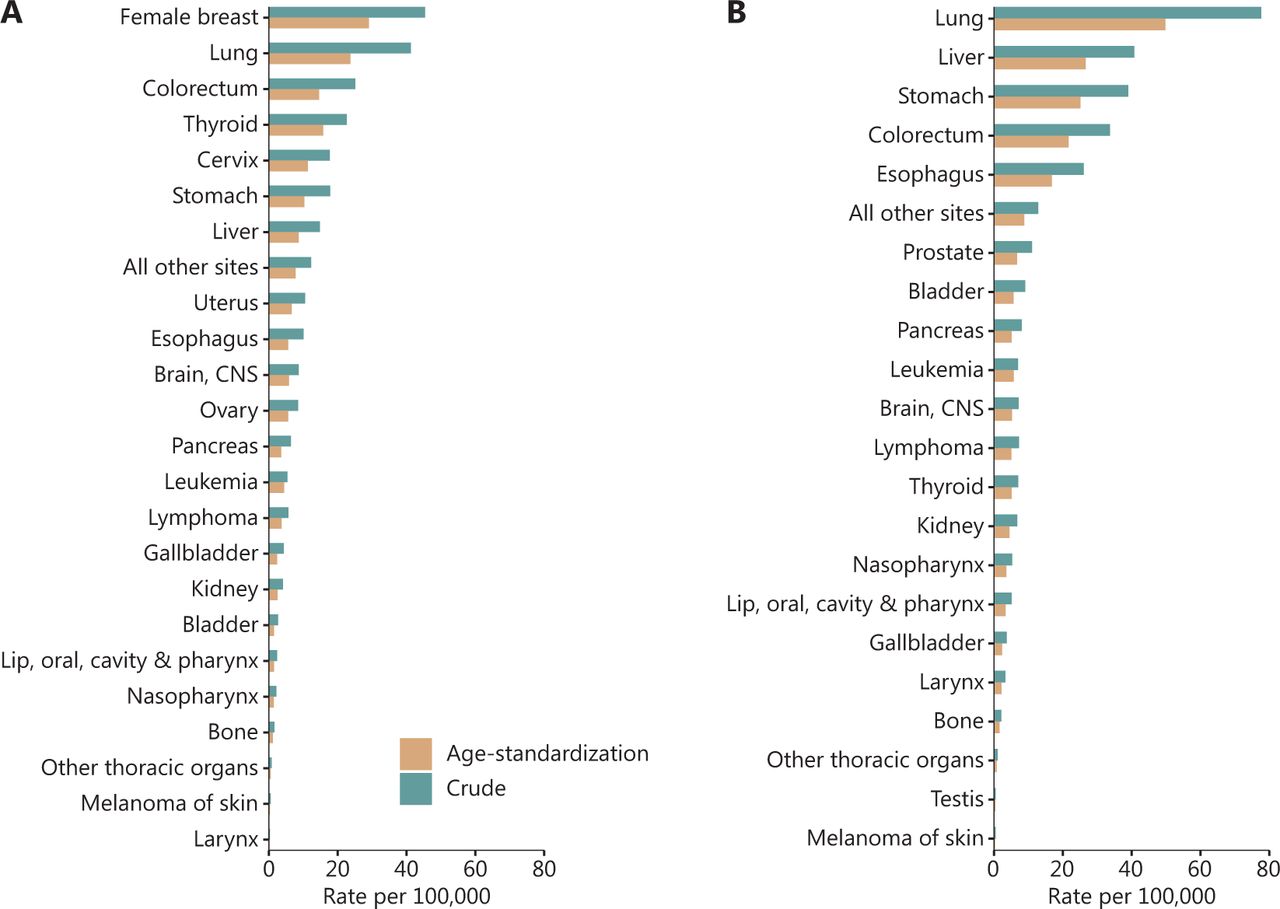
    Figure 1

    Crude and age-standardized incidence of cancer by sex (A. female, B. male). Data were extracted from Cancer incidence and mortality in China, 20161.

  • Figure 2
    • Download figure
    • Open in new tab
    • Download powerpoint
    Figure 2

    Crude and age-standardized mortality of cancer by sex (A. female, B. male). Data were extracted from Cancer incidence and mortality in China, 20161.

  • Figure 3
    • Download figure
    • Open in new tab
    • Download powerpoint
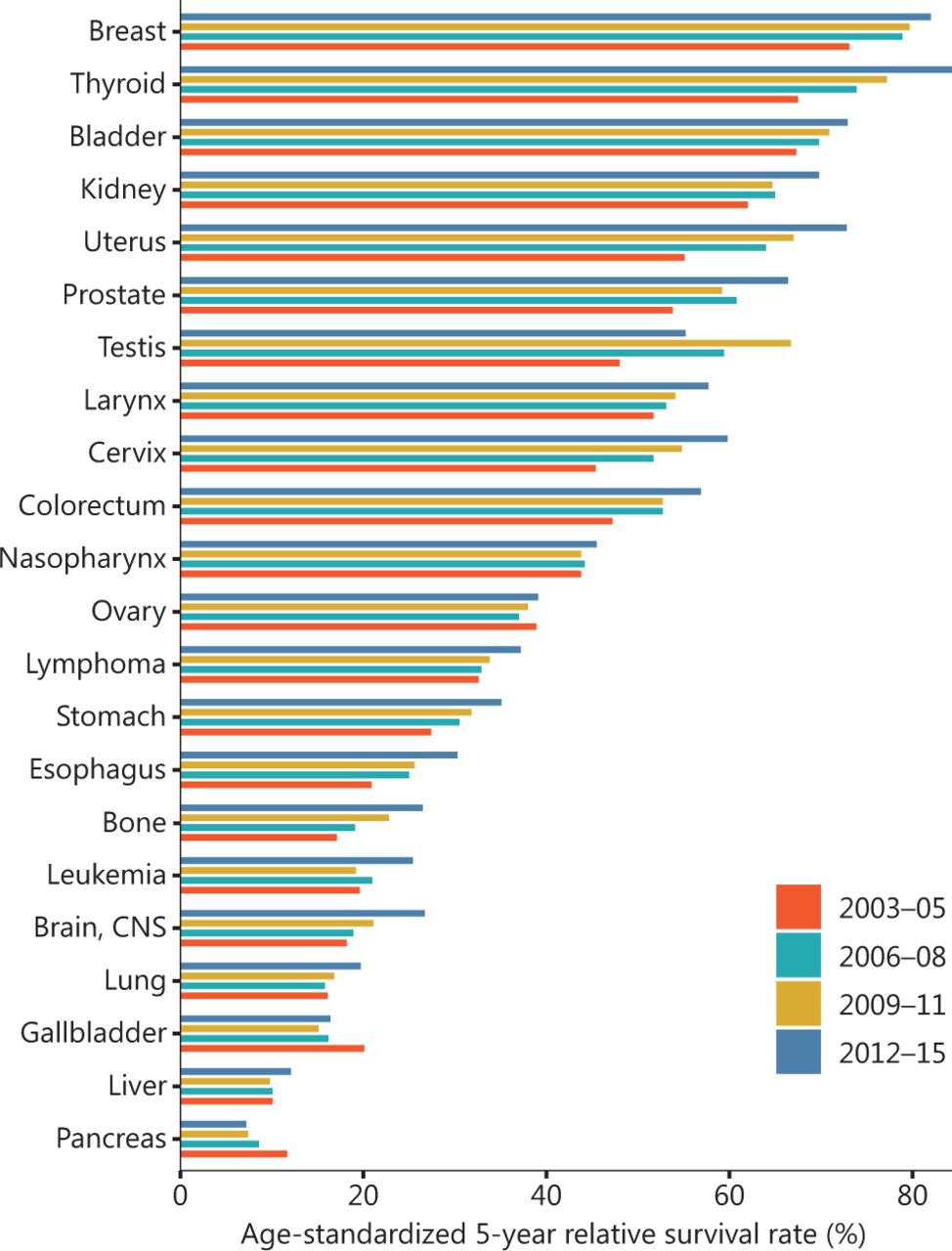
    Figure 3

    Age-standardized 5-year relative survival rates for the common cancers. Data were extracted from Changing cancer survival in China during 2003–2015: a pooled analysis of 17 population-based cancer registries7.

  • Figure 4
    • Download figure
    • Open in new tab
    • Download powerpoint
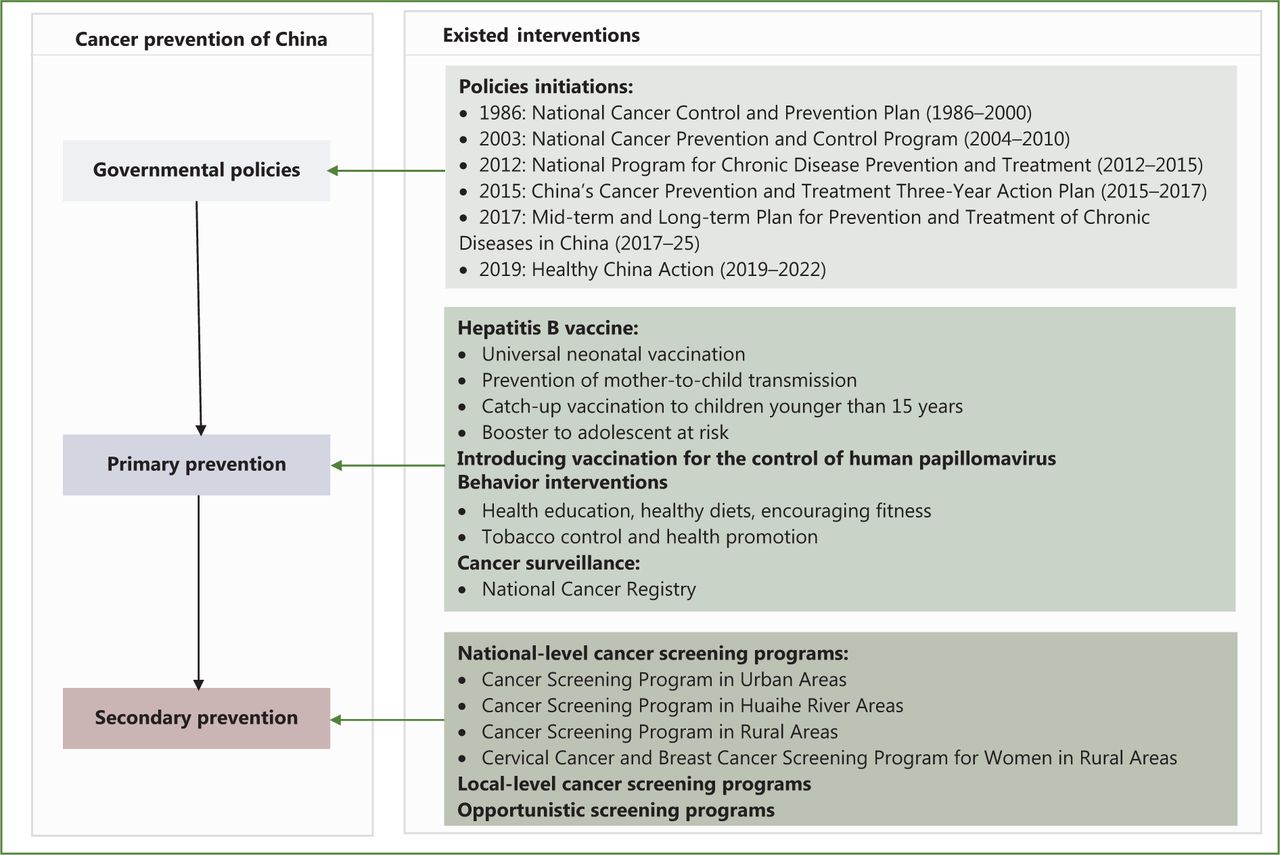
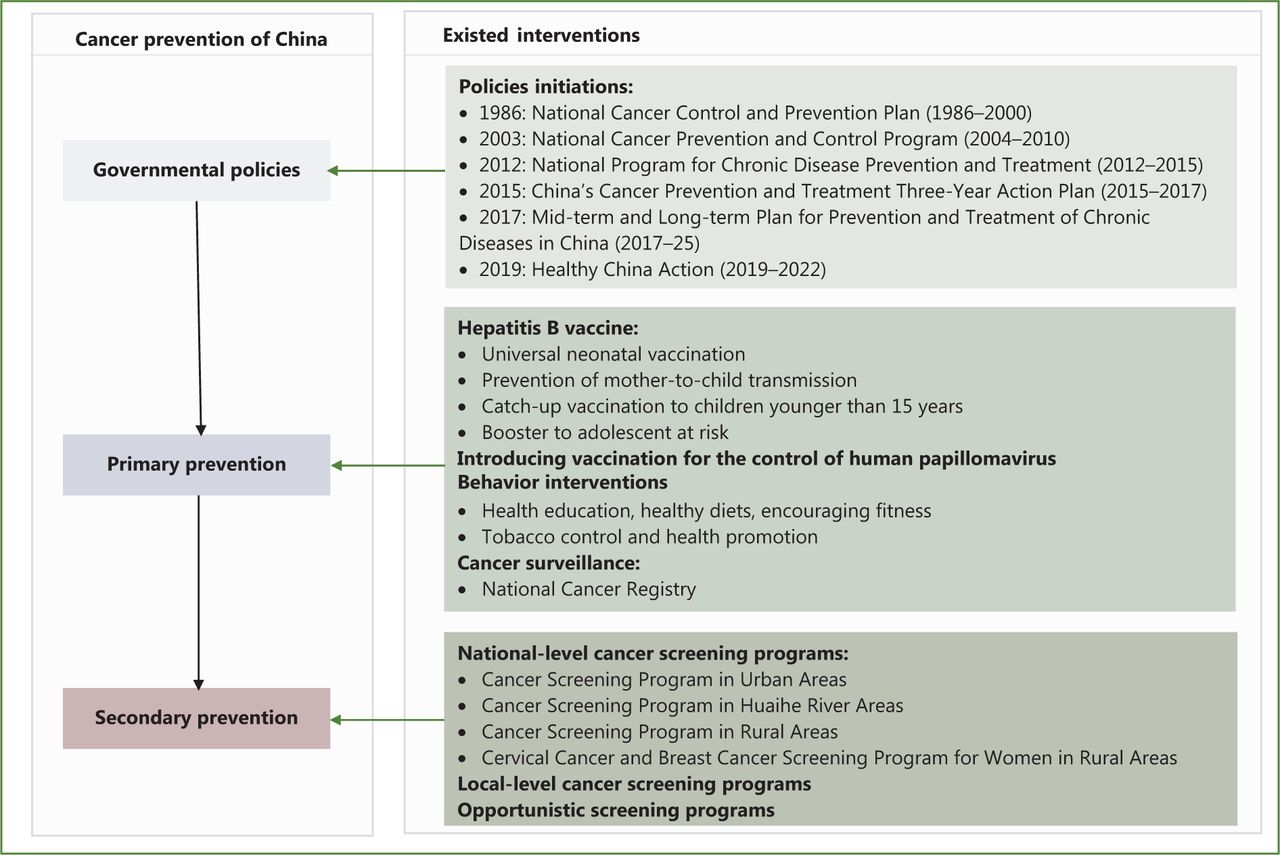
    Figure 4

    Measures for cancer prevention and control in China.
Tables

  • Figures
    • View popup
    Table 1

    The most frequent cancers in China by sex, 2016

    SiteOverallMenWomen
    CasesPercentage (%)RankCasesPercentage (%)RankCasesPercentage (%)Rank
    All sites4,064,000100.0–2,234,300100.0–1,829,600100.0–
    Lung828,10020.41549,80024.61278,30015.22
    Colon-rectum408,00010.02238,50010.74169,5009.33
    Stomach396,5009.83276,30012.43120,2006.65
    Liver388,8009.64288,80012.92100,0005.57
    Female breast306,0007.55–––306,00016.71
    Esophagus252,5006.26184,5008.3568,0003.710
    Thyroid202,6005.0750,0002.212152,6008.34
    All other sites173,6004.3890,9004.1682,7004.58
    Cervix119,3002.99–––119,3006.56
    Brain, CNS109,0002.71050,5002.31158,5003.211
    Pancreas100,4002.51157,0002.6943,4002.413
    Lymphoma89,9002.21251,6002.31038,3002.114
    Leukemia85,8002.11349,4002.21336,4002.015
    Bladder82,3002.01464,2002.9818,0001.018
    Prostate78,3001.91578,3003.57–––
    Kidney75,8001.91648,0002.11427,8001.517
    Uterus71,1001.717–––71,1003.99
    Ovary57,2001.418–––57,2003.112
    Gallbladder55,7001.41926,4001.21729,3001.616
    Lip, oral, cavity, and pharynx52,2001.32036,2001.61616,1000.919
    Nasopharynx52,0001.32137,4001.71514,7000.820
    Bone25,8000.62214,9000.71910,9000.621
    Larynx25,7000.62323,5001.1182,2000.124
    Other thoracic organs13,1000.3247,6000.3205,5000.322
    Melanoma of skin7,0000.2253,5000.2213,5000.223
    Testis3,4000.1263,4000.222––

    Cancer incidence and mortality in China, 20161.

      • View popup
      Table 2

      Leading causes of death in China by sex, 2016

      SiteOverallMenWomen
      DeathsPercentage (%)RankDeathsPercentage (%)RankDeathsPercentage (%)Rank
      All sites2,413,500100.0–1,530,700100.0–882,800100.0–
      Lung657,00027.21454,70029.71202,30022.91
      Liver336,40013.92249,60016.3286,8009.83
      Stomach288,50012.03200,20013.1388,40010.02
      Colon–rectum195,6008.14114,5007.5581,0009.24
      Esophagus193,9008.05142,3009.3451,6005.86
      All other sites93,4003.9653,5003.5639,9004.57
      Pancreas87,9003.6749,8003.3738,1004.38
      Female breast71,7003.08–––71,7008.15
      Brain, CNS58,5002.4932,6002.1925,9002.911
      Leukemia55,7002.31032,4002.11023,2002.612
      Lymphoma51,5002.11131,0002.01120,5002.314
      Gallbladder41,4001.71219,5001.31422,0002.513
      Cervix37,2001.513–––37,2004.29
      Bladder33,7001.41426,2001.7127,5000.918
      Prostate33,6001.41533,6002.28–––
      Ovary27,2001.116–––27,2003.110
      Kidney26,9001.11717,1001.1169,8001.116
      Nasopharynx26,7001.11819,7001.3137,0000.819
      Lip, oral, cavity, and pharynx25,8001.11918,9001.2156,9000.820
      Bone18,4000.82010,7000.7187,7000.917
      Uterus17,1000.721–––17,1001.915
      Larynx14,3000.62212,5000.8171,7000.223
      Thyroid8,3000.3233,1000.2205,2000.621
      Other thoracic organs6,8000.3244,3000.3192,5000.322
      Melanoma of skin38000.2252,1000.1211,7000.224
      Testis9000.0269000.122–––

      Cancer incidence and mortality in China, 20161.

        • View popup
        Table 3

        Leading causes of death in China

        YearRural (%)Urban (%)
        CancerHeart conditionsCerebrovascular diseaseRespiratory diseaseCancerHeart conditionsCerebrovascular diseaseRespiratory disease
        200018.412.418.423.124.417.721.313.3
        200117.713.119.022.524.917.620.413.4
        200220.714.317.315.623.514.617.515.6
        200325.312.023.818.725.514.420.014.6
        200423.712.514.913.323.918.819.113.1
        200520.311.821.223.522.917.921.212.6
        200625.113.920.416.427.317.117.713.1
        200724.814.820.617.228.516.318.013.1
        200825.414.121.716.927.119.719.611.9
        200924.317.223.215.027.020.820.410.5
        201023.117.923.414.226.320.920.211.0
        201123.619.421.713.327.821.320.210.6
        201223.018.120.615.826.821.519.612.3
        201322.421.922.911.525.521.620.312.4
        201423.021.722.912.126.222.120.412.0
        201523.221.823.212.126.422.020.611.8
        201622.922.223.312.026.122.620.611.2
        201723.122.723.211.626.123.020.610.9
        201823.023.523.211.226.023.320.510.8
        201923.323.822.910.825.723.720.610.4
        202023.124.523.59.125.424.621.38.7

        National Bureau of Statistics of China.

          • View popup
          Table 4

          Major causes of cancer-associated death from 1973 to 2005

          1973–1975 (year)1990–1992 (year)2004–2005 (year)
          SiteProportion (%)SiteProportion (%)SiteProportion (%)
          Stomach23.0Stomach23.2Lung22.7
          Esophagus22.3Liver18.8Liver19.3
          Liver15.1Lung16.2Stomach18.2
          Cervix7.6Esophagus16.1Esophagus11.2
          Lung7.4Colorectum4.9Colorectum5.2
          Colorectum5.3Leukemia3.4Leukemia2.8
          Leukemia3.8Cervix1.8Brain2.3
          Nasopharynx2.8Nasopharynx1.6Breast2.1
          Breast2.0Breast1.6Pancreas1.9
          Brain1.9Bladder0.9Bone1.3
          Others8.8Others11.5Others13.0

          Three National Retrospective Sampling Survey of Death Causes6.

          PreviousNext
          Back to top

          In this issue

          Cancer Biology & Medicine: 19 (8)
          Cancer Biology & Medicine
          Vol. 19, Issue 8
          15 Aug 2022
          • Table of Contents
          • Index by author
          Print
          Download PDF
          Email Article

          Thank you for your interest in spreading the word on Cancer Biology & Medicine.

          NOTE: We only request your email address so that the person you are recommending the page to knows that you wanted them to see it, and that it is not junk mail. We do not capture any email address.

          Enter multiple addresses on separate lines or separate them with commas.
          Current cancer burden in China: epidemiology, etiology, and prevention
          (Your Name) has sent you a message from Cancer Biology & Medicine
          (Your Name) thought you would like to see the Cancer Biology & Medicine web site.
          Citation Tools
          Current cancer burden in China: epidemiology, etiology, and prevention
          Maomao Cao, He Li, Dianqin Sun, Siyi He, Xinxin Yan, Fan Yang, Shaoli Zhang, Changfa Xia, Lin Lei, Ji Peng, Wanqing Chen
          Cancer Biology & Medicine Aug 2022, 19 (8) 1121-1138; DOI: 10.20892/j.issn.2095-3941.2022.0231

          Citation Manager Formats

          • BibTeX
          • Bookends
          • EasyBib
          • EndNote (tagged)
          • EndNote 8 (xml)
          • Medlars
          • Mendeley
          • Papers
          • RefWorks Tagged
          • Ref Manager
          • RIS
          • Zotero
          Share
          Current cancer burden in China: epidemiology, etiology, and prevention
          Maomao Cao, He Li, Dianqin Sun, Siyi He, Xinxin Yan, Fan Yang, Shaoli Zhang, Changfa Xia, Lin Lei, Ji Peng, Wanqing Chen
          Cancer Biology & Medicine Aug 2022, 19 (8) 1121-1138; DOI: 10.20892/j.issn.2095-3941.2022.0231
          Twitter logo Facebook logo Mendeley logo
          • Tweet Widget
          • Facebook Like
          • Google Plus One

          Jump to section

          • Article
            • Abstract
            • Introduction
            • Cancer epidemiology
            • Etiology and underlying modifiable risk factors
            • Cancer prevention and control
            • Expenditures and national insurance for cancer control
            • Limitations and challenges in cancer prevention
            • Grant support
            • Conflict of interest statement
            • Author contributions
            • Acknowledgments
            • References
          • Figures & Data
          • Info & Metrics
          • References
          • PDF

          Related Articles

          • No related articles found.
          • Google Scholar

          Cited By...

          • Social inequalities on Cancer Incidence and Mortality in a Brazilian City
          • Erianin inhibits the proliferation of lung cancer cells by suppressing mTOR activation and disrupting pyrimidine metabolism
          • Nomogram based on the log odds of negative lymph node/T stage can predict the prognosis of patients with colorectal cancer: a retrospective study based on SEER database and external validation in China
          • Clinical benefit and safety profile of cross-line therapy with CDK4/6 inhibitors: a retrospective study of HR+/HER2- advanced breast cancer
          • The role of reactive oxygen species in gastric cancer
          • Impact of cancer diagnosis on life expectancy by area-level socioeconomic groups in New South Wales, Australia: a population-based study
          • Esophageal cancer global burden profiles, trends, and contributors
          • Modeling human gastric cancers in immunocompetent mice
          • Advances in MET tyrosine kinase inhibitors in gastric cancer
          • Prognostic significance of grade of malignancy based on histopathological differentiation and Ki-67 in pancreatic ductal adenocarcinoma
          • Influence of sex on outcomes of liver transplantation for hepatocellular carcinoma: a multicenter cohort study in China
          • Blockade of CD300A enhances the ability of human NK cells to lyse hematologic malignancies
          • Bronchoalveolar lavage fluid assessment facilitates precision medicine for lung cancer
          • A retrospective analysis of mature T- and NK-cell lymphomas
          • Cervical cancer prevention in China: where are we now, and whats next?
          • Cancer-educated neutrophils promote lung cancer progression via PARP-1-ALOX5-mediated MMP-9 expression
          • DNA methylation biomarkers for early detection of gastric and colorectal cancers
          • Treatment strategies for patients with HER2-positive gastric cancer
          • Current therapeutic landscape and resistance mechanisms to larotrectinib
          • Single-arm trials for domestic oncology drug approvals in China
          • Cohort profile: design and methods of the Chinese colorectal, breast, lung, liver, and stomach cancer screening trial (C-BLAST)
          • Targeting endoplasmic reticulum stress signaling in ovarian cancer therapy
          • The inducible secreting TLR5 agonist, CBLB502, enhances the anti-tumor activity of CAR133-NK92 cells in colorectal cancer
          • Regulatory role of exosomes in colorectal cancer progression and potential as biomarkers
          • Nuclear PLD1 combined with NPM1 induces gemcitabine resistance through tumorigenic IL7R in pancreatic adenocarcinoma
          • The Hippo/YAP signaling pathway: the driver of cancer metastasis
          • Identification of the E2F1-RAD51AP1 axis as a key factor in MGMT-methylated GBM TMZ resistance
          • Development of glioblastoma organoids and their applications in personalized therapy
          • Neutrophils as key regulators of tumor immunity that restrict immune checkpoint blockade in liver cancer
          • Smart drug delivery systems to overcome drug resistance in cancer immunotherapy
          • Smart drug delivery systems to overcome drug resistance in cancer immunotherapy
          • Early detection of gastric cancer in China: progress and opportunities
          • Google Scholar

          More in this TOC Section

          • Harnessing the power of cancer-associated fibroblasts to revolutionize pancreatic cancer treatment
          • From residual risk to precision intervention: the evolving role of minimal residual disease in breast cancer management
          • Primary cilia in cancer: structures, functions, mechanisms, and therapeutic implications
          Show more Review

          Similar Articles

          Keywords

          • cancer burden
          • risk factor
          • prevention
          • China

          Navigate

          • Home
          • Current Issue

          More Information

          • About CBM
          • About CACA
          • About TMUCIH
          • Editorial Board
          • Subscription

          For Authors

          • Instructions for authors
          • Journal Policies
          • Submit a Manuscript

          Journal Services

          • Email Alerts
          • Facebook
          • RSS Feeds
          • Twitter


          © 2025 Cancer Biology & Medicine

          Powered by HighWire