

Main menu

  • Home
  • About
    • About CBM
    • Editorial Board
    • Announcement
  • Articles
    • Ahead of print
    • Current Issue
    • Archive
    • Collections
    • Cover Story
  • For Authors
    • Instructions for Authors
    • Resources
    • Submit a Manuscript
  • For Reviewers
    • Become a Reviewer
    • Instructions for Reviewers
    • Resources
    • Outstanding Reviewer
  • Subscription
  • Alerts
    • Email Alerts
    • RSS Feeds
    • Table of Contents
  • Contact us
  • Other Publications
    • cbm

User menu

  • My alerts

Search

  • Advanced search
Cancer Biology & Medicine
  • Other Publications
    • cbm
  • My alerts
Cancer Biology & Medicine

Advanced Search


  • Home
  • About
    • About CBM
    • Editorial Board
    • Announcement
  • Articles
    • Ahead of print
    • Current Issue
    • Archive
    • Collections
    • Cover Story
  • For Authors
    • Instructions for Authors
    • Resources
    • Submit a Manuscript
  • For Reviewers
    • Become a Reviewer
    • Instructions for Reviewers
    • Resources
    • Outstanding Reviewer
  • Subscription
  • Alerts
    • Email Alerts
    • RSS Feeds
    • Table of Contents
  • Contact us
  • Follow cbm on Twitter
  • Visit cbm on Facebook
Review ArticleReview

Anlotinib has good efficacy and low toxicity: a phase II study of anlotinib in pre-treated HER-2 negative metastatic breast cancer

Nanlin Hu, Yiran Si, Jian Yue, Tingting Sun, Xue Wang, Zhuqing Jia, Songlin Gao, Qiao Li, Yang Shao, Jiayu Wang, Yang Luo, Fei Ma, Binghe Xu and Peng Yuan
Cancer Biology & Medicine August 2021, 18 (3) 849-859; DOI: https://doi.org/10.20892/j.issn.2095-3941.2020.0463
Nanlin Hu
1Department of Medical Oncology, National Cancer Center/National Clinical Research Center for Cancer/Cancer Hospital, Chinese Academy of Medical Sciences and Peking Union Medical College, Beijing 100021, China
  • Find this author on Google Scholar
  • Find this author on PubMed
  • Search for this author on this site
Yiran Si
1Department of Medical Oncology, National Cancer Center/National Clinical Research Center for Cancer/Cancer Hospital, Chinese Academy of Medical Sciences and Peking Union Medical College, Beijing 100021, China
  • Find this author on Google Scholar
  • Find this author on PubMed
  • Search for this author on this site
Jian Yue
2Department of VIP Medical Services, National Cancer Center/National Clinical Research Center for Cancer/Cancer Hospital, Chinese Academy of Medical Sciences and Peking Union Medical College, Beijing 100021, China
  • Find this author on Google Scholar
  • Find this author on PubMed
  • Search for this author on this site
Tingting Sun
3Nanjing Geneseeq Technology Inc., Nanjing 210032, China
  • Find this author on Google Scholar
  • Find this author on PubMed
  • Search for this author on this site
Xue Wang
2Department of VIP Medical Services, National Cancer Center/National Clinical Research Center for Cancer/Cancer Hospital, Chinese Academy of Medical Sciences and Peking Union Medical College, Beijing 100021, China
  • Find this author on Google Scholar
  • Find this author on PubMed
  • Search for this author on this site
Zhuqing Jia
4Cancer Hospital of Huanxing Chaoyang District Beijing, Beijing 100021, China
  • Find this author on Google Scholar
  • Find this author on PubMed
  • Search for this author on this site
Songlin Gao
1Department of Medical Oncology, National Cancer Center/National Clinical Research Center for Cancer/Cancer Hospital, Chinese Academy of Medical Sciences and Peking Union Medical College, Beijing 100021, China
  • Find this author on Google Scholar
  • Find this author on PubMed
  • Search for this author on this site
Qiao Li
1Department of Medical Oncology, National Cancer Center/National Clinical Research Center for Cancer/Cancer Hospital, Chinese Academy of Medical Sciences and Peking Union Medical College, Beijing 100021, China
  • Find this author on Google Scholar
  • Find this author on PubMed
  • Search for this author on this site
Yang Shao
3Nanjing Geneseeq Technology Inc., Nanjing 210032, China
  • Find this author on Google Scholar
  • Find this author on PubMed
  • Search for this author on this site
Jiayu Wang
1Department of Medical Oncology, National Cancer Center/National Clinical Research Center for Cancer/Cancer Hospital, Chinese Academy of Medical Sciences and Peking Union Medical College, Beijing 100021, China
  • Find this author on Google Scholar
  • Find this author on PubMed
  • Search for this author on this site
Yang Luo
1Department of Medical Oncology, National Cancer Center/National Clinical Research Center for Cancer/Cancer Hospital, Chinese Academy of Medical Sciences and Peking Union Medical College, Beijing 100021, China
  • Find this author on Google Scholar
  • Find this author on PubMed
  • Search for this author on this site
Fei Ma
1Department of Medical Oncology, National Cancer Center/National Clinical Research Center for Cancer/Cancer Hospital, Chinese Academy of Medical Sciences and Peking Union Medical College, Beijing 100021, China
  • Find this author on Google Scholar
  • Find this author on PubMed
  • Search for this author on this site
Binghe Xu
1Department of Medical Oncology, National Cancer Center/National Clinical Research Center for Cancer/Cancer Hospital, Chinese Academy of Medical Sciences and Peking Union Medical College, Beijing 100021, China
  • Find this author on Google Scholar
  • Find this author on PubMed
  • Search for this author on this site
Peng Yuan
2Department of VIP Medical Services, National Cancer Center/National Clinical Research Center for Cancer/Cancer Hospital, Chinese Academy of Medical Sciences and Peking Union Medical College, Beijing 100021, China
  • Find this author on Google Scholar
  • Find this author on PubMed
  • Search for this author on this site
  • ORCID record for Peng Yuan
  • For correspondence: yuanpeng01{at}hotmail.com
  • Article
  • Figures & Data
  • Info & Metrics
  • References
  • PDF
Loading

Article Figures & Data

Figures

  • Tables
  • Supplementary Materials
  • Waterfall plot of the best percentage change in target lesion size.
    • Download figure
    • Open in new tab
    • Download powerpoint
    Figure 1

    Waterfall plot of the best percentage change in target lesion size.

  • Kaplan-Meier graph showing progression-free survival. (A) The median progression-free survival (PFS) of all patients (n = 26) was 5.22 months. (B) The median PFS of hormone receptor-positive (n = 16) and hormone receptor-negative (n = 10) patients was 5.88 months and 4.04 months, respectively, HR = 0.62, 95% CI (0.24–1.63), P = 0.32.
    • Download figure
    • Open in new tab
    • Download powerpoint
    Figure 2

    Kaplan-Meier graph showing progression-free survival. (A) The median progression-free survival (PFS) of all patients (n = 26) was 5.22 months. (B) The median PFS of hormone receptor-positive (n = 16) and hormone receptor-negative (n = 10) patients was 5.88 months and 4.04 months, respectively, HR = 0.62, 95% CI (0.24–1.63), P = 0.32.

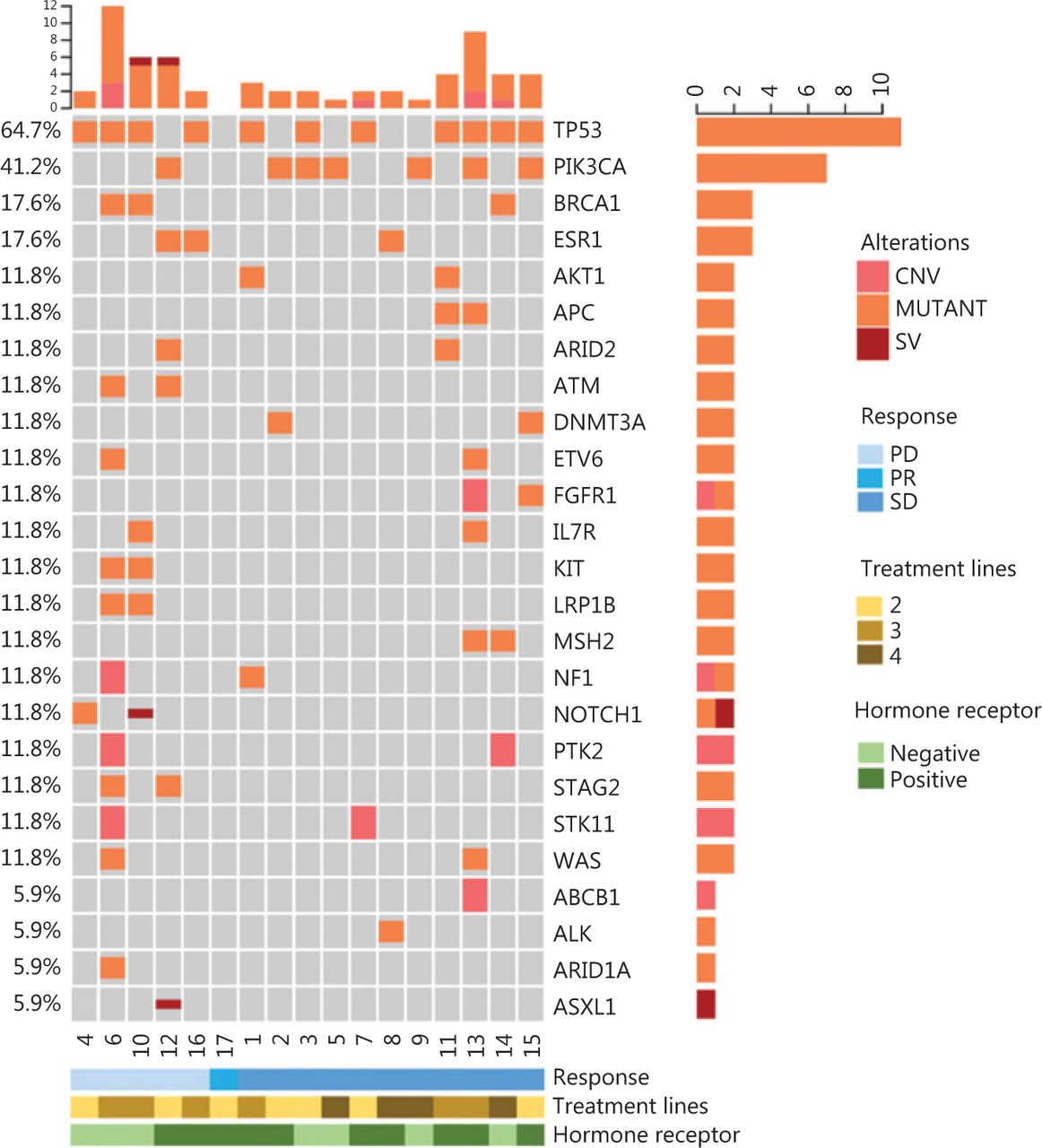
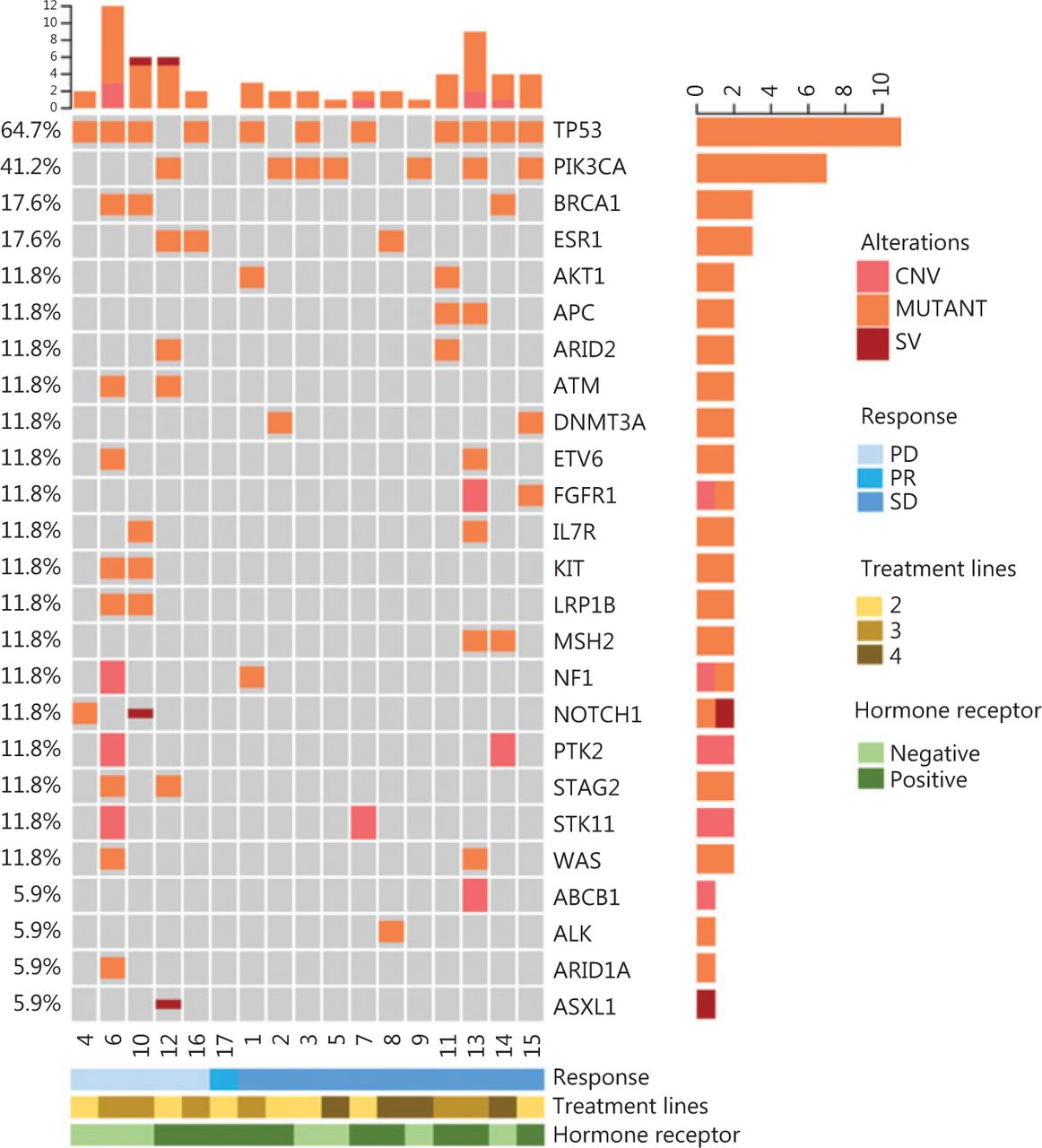
  • Distribution of the top 25 genomic alterations in the entire population at baseline.
    • Download figure
    • Open in new tab
    • Download powerpoint
    Figure 3

    Distribution of the top 25 genomic alterations in the entire population at baseline.

Tables

  • Figures
  • Supplementary Materials
    • View popup
    Table 1

    Patient characteristics at baseline

    CharacteristicsAnlotinib
    Total (n = 26)Hormone receptor positive (n = 16)Hormone receptor negative (n = 10)
    Age, median (range)56 (30–75)56 (30–75)50 (32–64)
    Age (years), n (%)
     ≥ 653 (11.54)3 (18.75)0
     < 6523 (88.46)13 (81.25)10 (100)
    ECOG, n (%)
     07 (26.92)5 (31.25)2 (20.00)
     116 (61.54)10 (62.50)6 (60.00)
     23 (11.54)1 (6.25)2 (20.00)
    Hormone receptor, n (%)
     Positive16 (61.54)16 (100)0
     Negative10 (38.46)010 (100)
    Type of metastatic site, n (%)
     Non-visceral4 (15.38)2 (12.50)2 (20.00)
     Visceral22 (84.62)14 (87.50)8 (80.00)
    Number of metastatic sites, n (%)
     13 (11.54)2 (12.50)1 (10.00)
     212 (46.15)7 (43.75)5 (50.00)
     ≥ 311 (42.31)7 (43.75)4 (40.00)
    Metastatic site, n (%)
     Lymph nodes13 (50.00)7 (43.75)6 (60.00)
     Liver9 (34.62)8 (50.00)1 (10.00)
     Lung17 (65.38)9 (56.25)8 (80.00)
     Pleural effusion6 (23.08)3 (18.75)3 (30.00)
     Chest wall2 (7.69)1 (6.25)1 (10.00)
     Pericardial effusion2 (7.69)02 (20.00)
     Bone15 (57.69)12 (75.00)3 (30.00)
    Neoadjuvant, n (%)
     Yes3 (11.54)1 (6.25)2 (20.00)
     No23 (88.46)15 (93.75)8 (80.00)
    Adjuvant chemotherapy, n (%)
     Yes23 (88.46)15 (93.75)10 (100)
     No3 (11.54)1 (6.25)0
    Adjuvant endocrine therapy, n (%)
     Yes16 (61.54)16 (100)0
     No10 (38.46)010 (100)
    Previous lines of systematic treatment, n (%)
     ≤ 214 (53.85)8 (50.00)6 (60.00)
     ≥ 312 (46.15)8 (50.00)4 (40.00)
    Type of previous endocrine therapy combined with target therapy, n (%)
      Both CDK/4/6 inhibitor and mTOR inhibitor3 (11.54)3 3 (18.75)0
     Only CDK4/6 inhibitor2 (7.69)2 (12.50)0
     Only mTOR inhibitor2 (7.69)2 (12.50)0
    Previous chemotherapy after metastasis, n (%)
     Taxanes26 (100)16 (100)10 (100)
     Fluorouracil†22 (84.62)12 (75.00)10 (100)
     Platinum10 (38.46)3 (18.75)7 (70.00)
     Others‡17 (65.38)10 (62.50)7 (70.00)

    ECOG, Eastern Cooperative Oncology Group.†Including capecitabine and S-1. ‡Other drugs, including gemcitabine, vinorelbine, and etoposide.

      • View popup
      Table 2

      Treatment response

      TotalHormone receptor positiveHormone receptor negativeStatistics
      Numbers261610
      ORR (%)15.3818.7510
      95% CI(4.36–34.87)(4.05–45.65)(0.25–44.50)P = 1.00†
      DCR (%)80.7787.570
      95% CI(60.65–93.45)(61.65–98.45)(34.75–93.33)P = 0.34‡
      Numbers censoring, n (%)8 (30.77)6 (37.50)2 (20.00)
      Median PFS5.225.884.04
      95% CI(2.86–6.24)(1.94–8.87)(1.87–6.24)
      HR§–––0.62, χ2 = 0.9595
      95% CI§–––(0.24–1.63), P = 0.32

      PFS, progression-free survival; CI, confidence interval; HR, hazard ratio; ORR, objective response rate; DCR, disease control rate.†The ORR/DCR comparison between groups (positive vs. triple negative) was analyzed with Fisher’s exact test. ‡The 95% CI of the ORR/DCR was calculated with the Clopper-Pearson method. §The comparison of progression-free survival between 2 groups (hormone receptor positive vs. hormone receptor negative) was performed with a log-rank test. The HR and 95% CI (hormone receptor positive vs. hormone receptor negative) were estimated with the Cox proportional-hazards model.

        • View popup
        Table 3

        Summary of treatment-related adverse events

        Adverse eventsAll grades, n (%)Grade 1, n (%)Grade 2, n (%)Grades 3–4, n (%)
        Fatigue4 (15.38)3 (11.54)1 (3.85)0 (0)
        Anorexia2 (7.69)0 (0)2 (7.69)0 (0)
        Weight loss1 (3.85)1 (3.85)0 (0)0 (0)
        Pharyngalgia3 (11.54)3 (11.54)0 (0)0 (0)
        Mucositis oral1 (3.85)1 (3.85)0 (0)0 (0)
        Cough2 (7.69)2 (7.69)0 (0)0 (0)
        Hand-foot syndrome6 (23.08)5 (19.23)0 (0)1 (3.85)
        Urinary tract infection1 (3.85)0 (0)1 (3.85)0 (0)
        Hematuria2 (7.69)2 (7.69)0 (0)0 (0)
        Proteinuria4 (15.38)4 (15.38)0 (0)0 (0)
        Hypertension15 (57.69)4 (15.38)4 (15.38)7 (26.92)
        TSH elevation9 (34.62)9 (34.62)0 (0)0 (0)
        Hypothyroidism2 (7.69)2 (7.69)0 (0)0 (0)
        Hypertriglyceridemia1 (3.85)1 (3.85)0 (0)0 (0)
        Hypercholesterolemia1 (3.85)1 (3.85)0 (0)0 (0)
        LDL elevation2 (7.69)2 (7.69)0 (0)0 (0)
        Alanine aminotransferase2 (7.69)1 (3.85)1 (3.85)0 (0)
        Aspartate aminotransferase1 (3.85)0 (0)1 (3.85)0 (0)

        LDL, low-density lipoprotein; TSH, thyroid-stimulating hormone.
        Supplementary Materials

        • Figures
        • Tables
        • [cbm-18-849-s001.pdf]
        PreviousNext
        Back to top

        In this issue

        Cancer Biology and Medicine: 18 (3)
        Cancer Biology & Medicine
        Vol. 18, Issue 3
        1 Aug 2021
        • Table of Contents
        • Index by author
        Print
        Download PDF
        Email Article

        Thank you for your interest in spreading the word on Cancer Biology & Medicine.

        NOTE: We only request your email address so that the person you are recommending the page to knows that you wanted them to see it, and that it is not junk mail. We do not capture any email address.

        Enter multiple addresses on separate lines or separate them with commas.
        Anlotinib has good efficacy and low toxicity: a phase II study of anlotinib in pre-treated HER-2 negative metastatic breast cancer
        (Your Name) has sent you a message from Cancer Biology & Medicine
        (Your Name) thought you would like to see the Cancer Biology & Medicine web site.
        Citation Tools
        Anlotinib has good efficacy and low toxicity: a phase II study of anlotinib in pre-treated HER-2 negative metastatic breast cancer
        Nanlin Hu, Yiran Si, Jian Yue, Tingting Sun, Xue Wang, Zhuqing Jia, Songlin Gao, Qiao Li, Yang Shao, Jiayu Wang, Yang Luo, Fei Ma, Binghe Xu, Peng Yuan
        Cancer Biology & Medicine Aug 2021, 18 (3) 849-859; DOI: 10.20892/j.issn.2095-3941.2020.0463

        Citation Manager Formats

        • BibTeX
        • Bookends
        • EasyBib
        • EndNote (tagged)
        • EndNote 8 (xml)
        • Medlars
        • Mendeley
        • Papers
        • RefWorks Tagged
        • Ref Manager
        • RIS
        • Zotero
        Share
        Anlotinib has good efficacy and low toxicity: a phase II study of anlotinib in pre-treated HER-2 negative metastatic breast cancer
        Nanlin Hu, Yiran Si, Jian Yue, Tingting Sun, Xue Wang, Zhuqing Jia, Songlin Gao, Qiao Li, Yang Shao, Jiayu Wang, Yang Luo, Fei Ma, Binghe Xu, Peng Yuan
        Cancer Biology & Medicine Aug 2021, 18 (3) 849-859; DOI: 10.20892/j.issn.2095-3941.2020.0463
        Twitter logo Facebook logo Mendeley logo
        • Tweet Widget
        • Facebook Like
        • Google Plus One

        Jump to section

        • Article
          • Abstract
          • Introduction
          • Materials and methods
          • Results
          • Discussion
          • Conclusions
          • Supporting Information
          • Grant support
          • Acknowledgements
          • Footnotes
          • References
        • Figures & Data
        • Info & Metrics
        • References
        • PDF

        Related Articles

        • No related articles found.
        • Google Scholar

        Cited By...

        • Association between homologous recombination deficiency and outcomes with platinum and platinum-free chemotherapy in patients with triple-negative breast cancer
        • Google Scholar

        More in this TOC Section

        • Tumor microenvironment-driven natural killer cell diversity: mechanisms and therapeutic opportunities
        • Harnessing the microbiome: a new frontier in lung cancer immunotherapy
        • Surgery-centered integrated strategies for personalized hepatocellular carcinoma care
        Show more Review

        Similar Articles

        Keywords

        • anlotinib
        • Angiogenesis
        • HER2-negative
        • Breast cancer
        • ctDNA

        Navigate

        • Home
        • Current Issue

        More Information

        • About CBM
        • About CACA
        • About TMUCIH
        • Editorial Board
        • Subscription

        For Authors

        • Instructions for authors
        • Journal Policies
        • Submit a Manuscript

        Journal Services

        • Email Alerts
        • Facebook
        • RSS Feeds
        • Twitter


        © 2026 Cancer Biology & Medicine

        Powered by HighWire