

Main menu

  • Home
  • About
    • About CBM
    • Editorial Board
    • Announcement
  • Articles
    • Ahead of print
    • Current Issue
    • Archive
    • Collections
    • Cover Story
  • For Authors
    • Instructions for Authors
    • Resources
    • Submit a Manuscript
  • For Reviewers
    • Become a Reviewer
    • Instructions for Reviewers
    • Resources
    • Outstanding Reviewer
  • Subscription
  • Alerts
    • Email Alerts
    • RSS Feeds
    • Table of Contents
  • Contact us
  • Other Publications
    • cbm

User menu

  • My alerts

Search

  • Advanced search
Cancer Biology & Medicine
  • Other Publications
    • cbm
  • My alerts
Cancer Biology & Medicine

Advanced Search


  • Home
  • About
    • About CBM
    • Editorial Board
    • Announcement
  • Articles
    • Ahead of print
    • Current Issue
    • Archive
    • Collections
    • Cover Story
  • For Authors
    • Instructions for Authors
    • Resources
    • Submit a Manuscript
  • For Reviewers
    • Become a Reviewer
    • Instructions for Reviewers
    • Resources
    • Outstanding Reviewer
  • Subscription
  • Alerts
    • Email Alerts
    • RSS Feeds
    • Table of Contents
  • Contact us
  • Follow cbm on Twitter
  • Visit cbm on Facebook
Research ArticleOriginal Article

Molecular heterogeneity of anti-PD-1/PD-L1 immunotherapy efficacy is correlated with tumor immune microenvironment in East Asian patients with non-small cell lung cancer

Runsen Jin, Chengming Liu, Sufei Zheng, Xinfeng Wang, Xiaoli Feng, Hecheng Li, Nan Sun and Jie He
Cancer Biology & Medicine August 2020, 17 (3) 768-781; DOI: https://doi.org/10.20892/j.issn.2095-3941.2020.0121
Runsen Jin
1Department of Thoracic Surgery, National Cancer Center/National Clinical Research Center for Cancer/Cancer Hospital, Chinese Academy of Medical Sciences and Peking Union Medical College, Beijing 100021, China
2Department of Thoracic Surgery, Ruijin Hospital, Shanghai Jiao Tong University School of Medicine, Shanghai 200025, China
  • Find this author on Google Scholar
  • Find this author on PubMed
  • Search for this author on this site
Chengming Liu
1Department of Thoracic Surgery, National Cancer Center/National Clinical Research Center for Cancer/Cancer Hospital, Chinese Academy of Medical Sciences and Peking Union Medical College, Beijing 100021, China
  • Find this author on Google Scholar
  • Find this author on PubMed
  • Search for this author on this site
Sufei Zheng
1Department of Thoracic Surgery, National Cancer Center/National Clinical Research Center for Cancer/Cancer Hospital, Chinese Academy of Medical Sciences and Peking Union Medical College, Beijing 100021, China
  • Find this author on Google Scholar
  • Find this author on PubMed
  • Search for this author on this site
Xinfeng Wang
1Department of Thoracic Surgery, National Cancer Center/National Clinical Research Center for Cancer/Cancer Hospital, Chinese Academy of Medical Sciences and Peking Union Medical College, Beijing 100021, China
  • Find this author on Google Scholar
  • Find this author on PubMed
  • Search for this author on this site
Xiaoli Feng
3Department of Pathology, National Cancer Center/National Clinical Research Center for Cancer/Cancer Hospital, Chinese Academy of Medical Sciences and Peking Union Medical College, Beijing 100021, China
  • Find this author on Google Scholar
  • Find this author on PubMed
  • Search for this author on this site
Hecheng Li
2Department of Thoracic Surgery, Ruijin Hospital, Shanghai Jiao Tong University School of Medicine, Shanghai 200025, China
  • Find this author on Google Scholar
  • Find this author on PubMed
  • Search for this author on this site
Nan Sun
1Department of Thoracic Surgery, National Cancer Center/National Clinical Research Center for Cancer/Cancer Hospital, Chinese Academy of Medical Sciences and Peking Union Medical College, Beijing 100021, China
  • Find this author on Google Scholar
  • Find this author on PubMed
  • Search for this author on this site
  • ORCID record for Nan Sun
  • For correspondence: sunnan{at}vip.126.com prof.jiehe{at}gmail.com
Jie He
1Department of Thoracic Surgery, National Cancer Center/National Clinical Research Center for Cancer/Cancer Hospital, Chinese Academy of Medical Sciences and Peking Union Medical College, Beijing 100021, China
  • Find this author on Google Scholar
  • Find this author on PubMed
  • Search for this author on this site
  • ORCID record for Jie He
  • For correspondence: sunnan{at}vip.126.com prof.jiehe{at}gmail.com
  • Article
  • Figures & Data
  • Info & Metrics
  • References
  • PDF
Loading

Article Figures & Data

Figures

  • Supplementary Materials
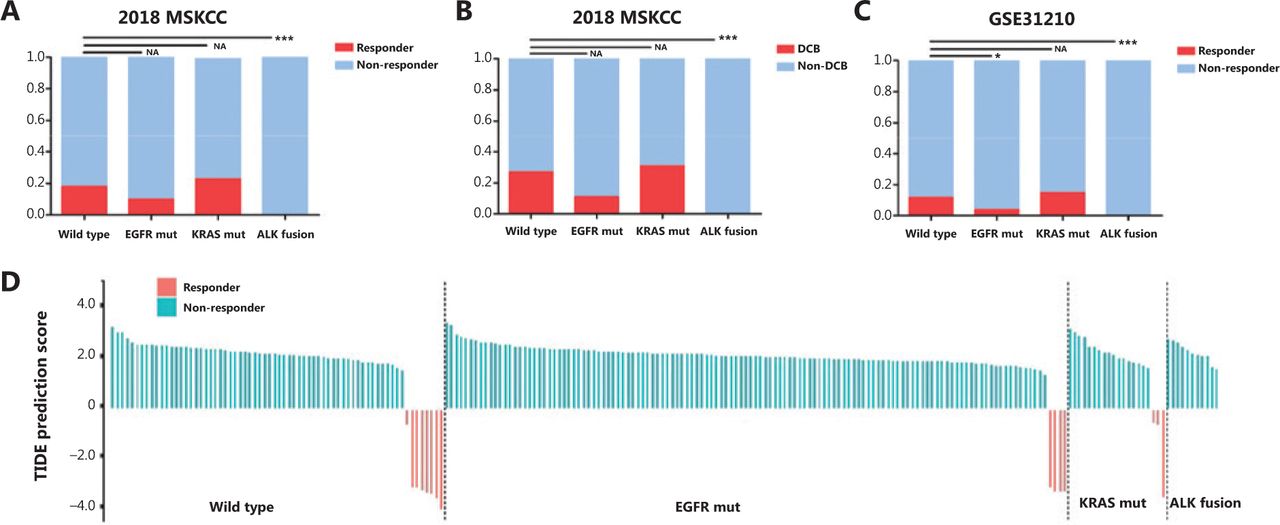
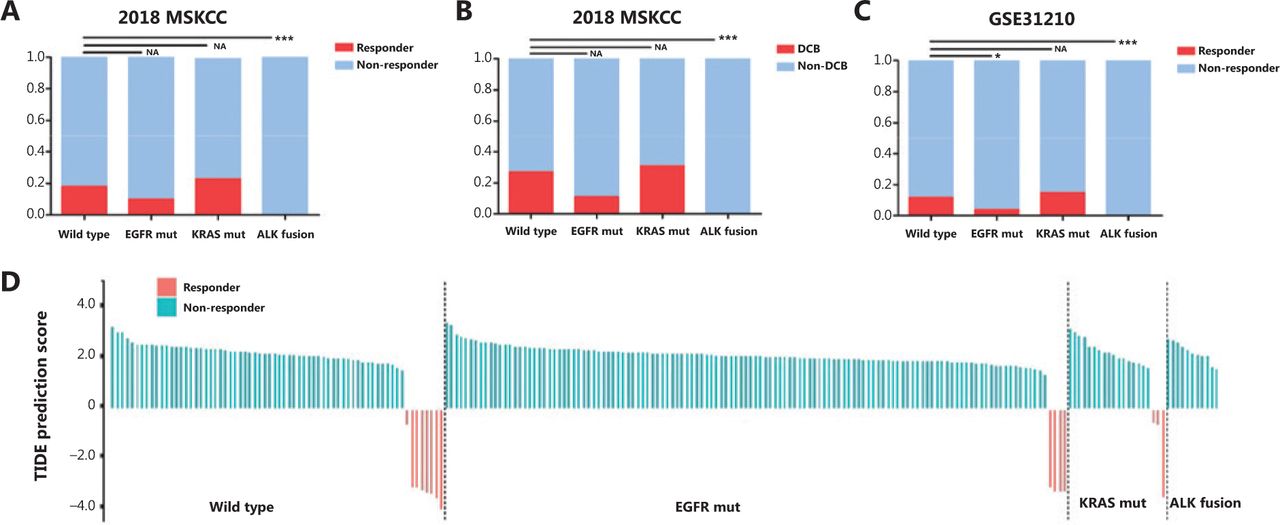
  • Correlation between the efficacy of anti-PD-1/PD-L1 immunotherapy and classic driver oncogene mutations in non-small cell lung cancer (NSCLC) patients. (A and B) Box plots evaluating objective response rate (A) and durable clinical benefit (progression-free survival > 6 months) (B) of NSCLC patients harboring EGFR mutations, KRAS mutations, and ALK fusions after initiation of PD-1/PD-L1 blockade treatment, in the 2018 MSKCC database. (C) A box plot evaluating the objective response rate of NSCLC patients, using TIDE prediction scores in the GSE31210 database. (D) A waterfall plot of TIDE prediction scores across 226 NSCLC tumors in the GSE31210 database. Red indicates a tumor that responded to therapy. Blue indicates non-responders. Tumors were divided into 4 categories based on the molecular genotype of NSCLC. In each category, we sorted tumors in descending order according to their TIDE prediction scores. *P < 0.05; **P < 0.01; ***P < 0.001. EGFR mut, EGFR mutation; KRAS mut, KRAS mutation; DCB, durable clinical benefit; Non-DCB, no durable clinical benefit.
    • Download figure
    • Open in new tab
    • Download powerpoint
    Figure 1

    Correlation between the efficacy of anti-PD-1/PD-L1 immunotherapy and classic driver oncogene mutations in non-small cell lung cancer (NSCLC) patients. (A and B) Box plots evaluating objective response rate (A) and durable clinical benefit (progression-free survival > 6 months) (B) of NSCLC patients harboring EGFR mutations, KRAS mutations, and ALK fusions after initiation of PD-1/PD-L1 blockade treatment, in the 2018 MSKCC database. (C) A box plot evaluating the objective response rate of NSCLC patients, using TIDE prediction scores in the GSE31210 database. (D) A waterfall plot of TIDE prediction scores across 226 NSCLC tumors in the GSE31210 database. Red indicates a tumor that responded to therapy. Blue indicates non-responders. Tumors were divided into 4 categories based on the molecular genotype of NSCLC. In each category, we sorted tumors in descending order according to their TIDE prediction scores. *P < 0.05; **P < 0.01; ***P < 0.001. EGFR mut, EGFR mutation; KRAS mut, KRAS mutation; DCB, durable clinical benefit; Non-DCB, no durable clinical benefit.

  • Meta-analysis of the association between PD-L1 expression and EGFR mutation status in non-small cell lung cancer (NSCLC) patients. (A) A forest plot of studies evaluating PD-L1 expression between EGFR wild-type and EGFR mutation patients. Pooled odds ratios of EGFR group analysis were computed using a random-effects model. (B) A forest plot of studies evaluating PD-L1 expression between EGFR Ex19del mutation and EGFR L858R mutation. Pooled odds ratios of EGFR subgroup analyses were computed using a fixed-effects model. CI, confidence interval.
    • Download figure
    • Open in new tab
    • Download powerpoint
    Figure 2

    Meta-analysis of the association between PD-L1 expression and EGFR mutation status in non-small cell lung cancer (NSCLC) patients. (A) A forest plot of studies evaluating PD-L1 expression between EGFR wild-type and EGFR mutation patients. Pooled odds ratios of EGFR group analysis were computed using a random-effects model. (B) A forest plot of studies evaluating PD-L1 expression between EGFR Ex19del mutation and EGFR L858R mutation. Pooled odds ratios of EGFR subgroup analyses were computed using a fixed-effects model. CI, confidence interval.

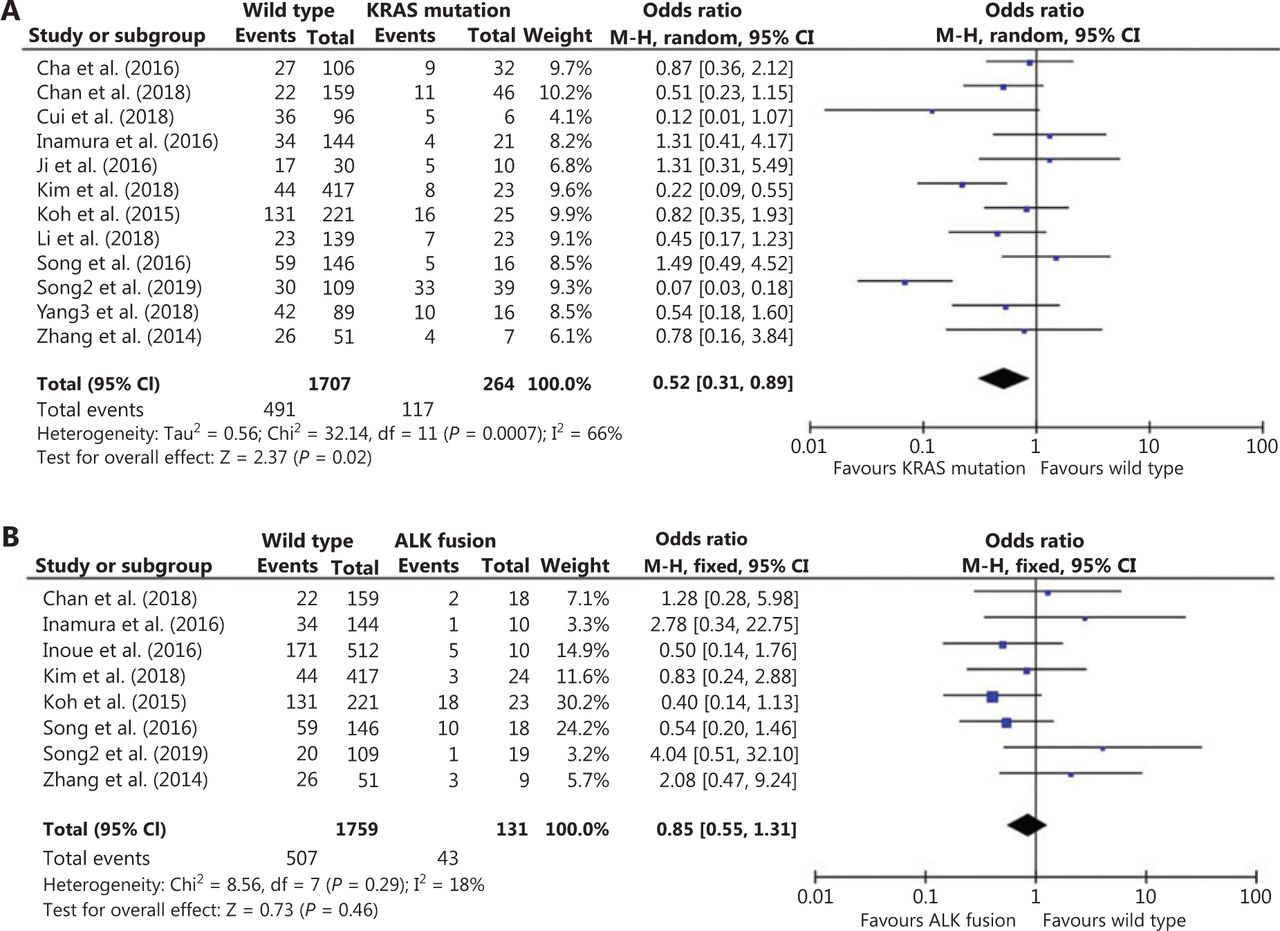
  • Meta-analysis of the association between PD-L1 expression and KRAS or ALK mutation status in non-small-cell lung cancer (NSCLC) patients. (A) A forest plot of studies evaluating PD-L1 expression between KRAS wild-type and KRAS mutation patients. Pooled odds ratios of KRAS group analysis were computed using a random-effects model. (B) A forest plot of studies evaluating PD-L1 expression between ALK wild-type and ALK fusion patients. Pooled odds ratios of ALK group analyses were computed using a fixed-effects model. CI, confidence interval.
    • Download figure
    • Open in new tab
    • Download powerpoint
    Figure 3

    Meta-analysis of the association between PD-L1 expression and KRAS or ALK mutation status in non-small-cell lung cancer (NSCLC) patients. (A) A forest plot of studies evaluating PD-L1 expression between KRAS wild-type and KRAS mutation patients. Pooled odds ratios of KRAS group analysis were computed using a random-effects model. (B) A forest plot of studies evaluating PD-L1 expression between ALK wild-type and ALK fusion patients. Pooled odds ratios of ALK group analyses were computed using a fixed-effects model. CI, confidence interval.

  • Correlation between the tumor microenvironment based on PD-L1 and CD8+ T cell infiltration and classic driver oncogene mutations in non-small-cell lung cancer (NSCLC) patients. (A and B) Immunohistochemical (IHC) analysis of PD-L1 expression (A) and CD8+ T cell infiltration (B) according to molecular genotype of NSCLC in a cohort of 629 resected NSCLC samples. (C and D) IHC analyses of PD-L1 expression (C) and CD8+ T cell infiltration (D) according to EGFR mutation status. (E) Representative IHC images show classifications of tumor microenvironments based on PD-L1 expression and CD8+ T cell infiltration. Scale bar = 200 ?m. (F and G) IHC analysis of the tumor microenvironment based on PD-L1 and CD8+ T cell infiltration according to the molecular genotype of NSCLC (F) and EGFR mutation status (G). PD-L1−/TIL−: PD-L1 TPS < 1% and CD8+ TIL density < 1%; PD-L1+/TIL−: PD-L1 TPS ≥ 1% and CD8+ TIL density < 1%; PD-L1−/TIL+: PD-L1 TPS < 1% and CD8+ TIL density ≥ 1%; PD-L1+/TIL+: PD-L1 TPS ≥ 1% and CD8+ TIL density ≥ 1%. *P < 0.05, **P < 0.01. EGFR mut, EGFR mutation; KRAS mut, KRAS mutation.
    • Download figure
    • Open in new tab
    • Download powerpoint
    Figure 4

    Correlation between the tumor microenvironment based on PD-L1 and CD8+ T cell infiltration and classic driver oncogene mutations in non-small-cell lung cancer (NSCLC) patients. (A and B) Immunohistochemical (IHC) analysis of PD-L1 expression (A) and CD8+ T cell infiltration (B) according to molecular genotype of NSCLC in a cohort of 629 resected NSCLC samples. (C and D) IHC analyses of PD-L1 expression (C) and CD8+ T cell infiltration (D) according to EGFR mutation status. (E) Representative IHC images show classifications of tumor microenvironments based on PD-L1 expression and CD8+ T cell infiltration. Scale bar = 200 ?m. (F and G) IHC analysis of the tumor microenvironment based on PD-L1 and CD8+ T cell infiltration according to the molecular genotype of NSCLC (F) and EGFR mutation status (G). PD-L1−/TIL−: PD-L1 TPS < 1% and CD8+ TIL density < 1%; PD-L1+/TIL−: PD-L1 TPS ≥ 1% and CD8+ TIL density < 1%; PD-L1−/TIL+: PD-L1 TPS < 1% and CD8+ TIL density ≥ 1%; PD-L1+/TIL+: PD-L1 TPS ≥ 1% and CD8+ TIL density ≥ 1%. *P < 0.05, **P < 0.01. EGFR mut, EGFR mutation; KRAS mut, KRAS mutation.

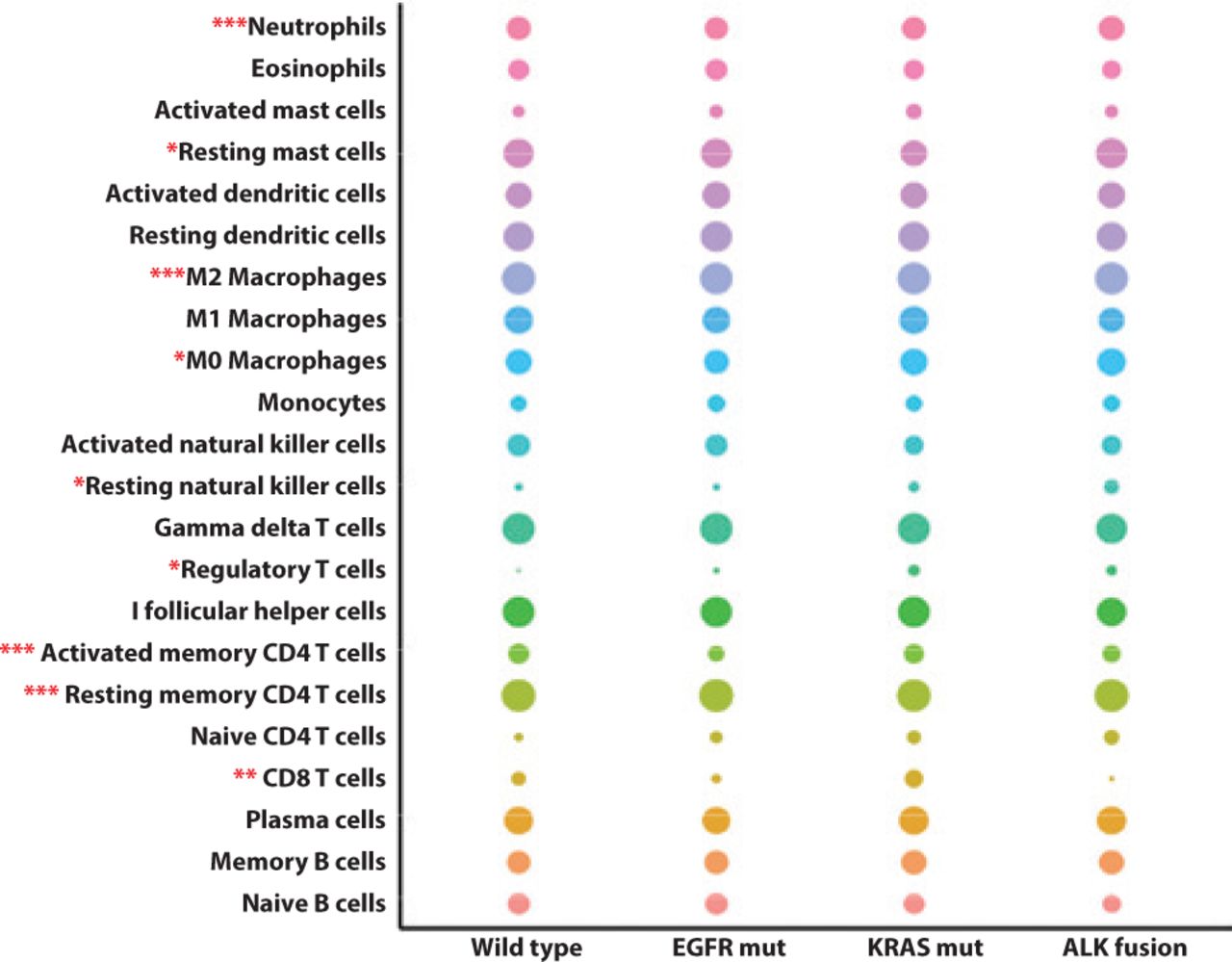
  • Correlation between infiltrated immune cell composition and classic driver oncogene mutations in non-small cell lung cancer (NSCLC) patients. The size of the bubble represents the numeric value of immune cell fraction. *P < 0.05; **P < 0.01; ***P < 0.001. EGFR mut, EGFR mutation; KRAS mut, KRAS mutation.
    • Download figure
    • Open in new tab
    • Download powerpoint
    Figure 5

    Correlation between infiltrated immune cell composition and classic driver oncogene mutations in non-small cell lung cancer (NSCLC) patients. The size of the bubble represents the numeric value of immune cell fraction. *P < 0.05; **P < 0.01; ***P < 0.001. EGFR mut, EGFR mutation; KRAS mut, KRAS mutation.

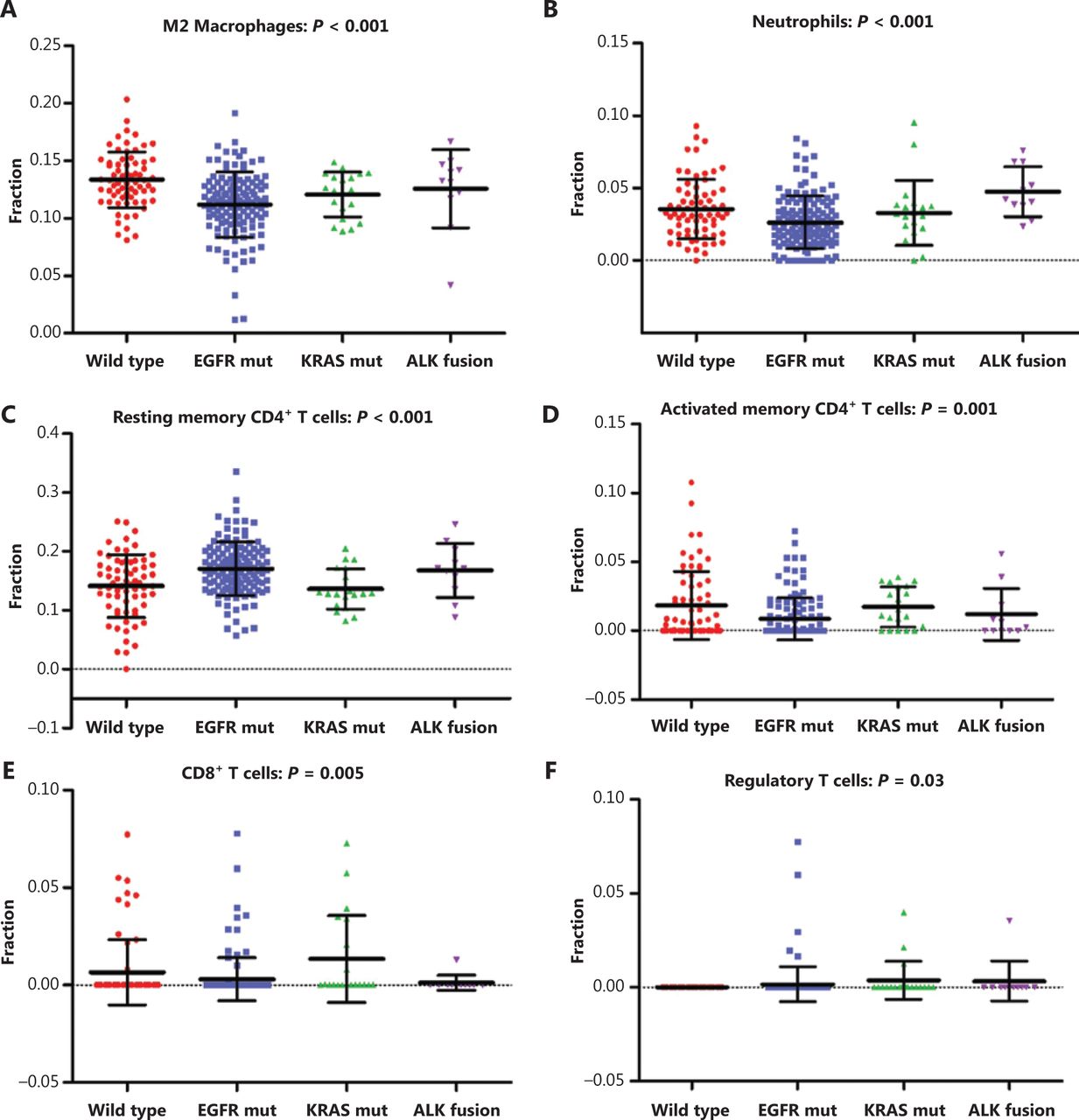
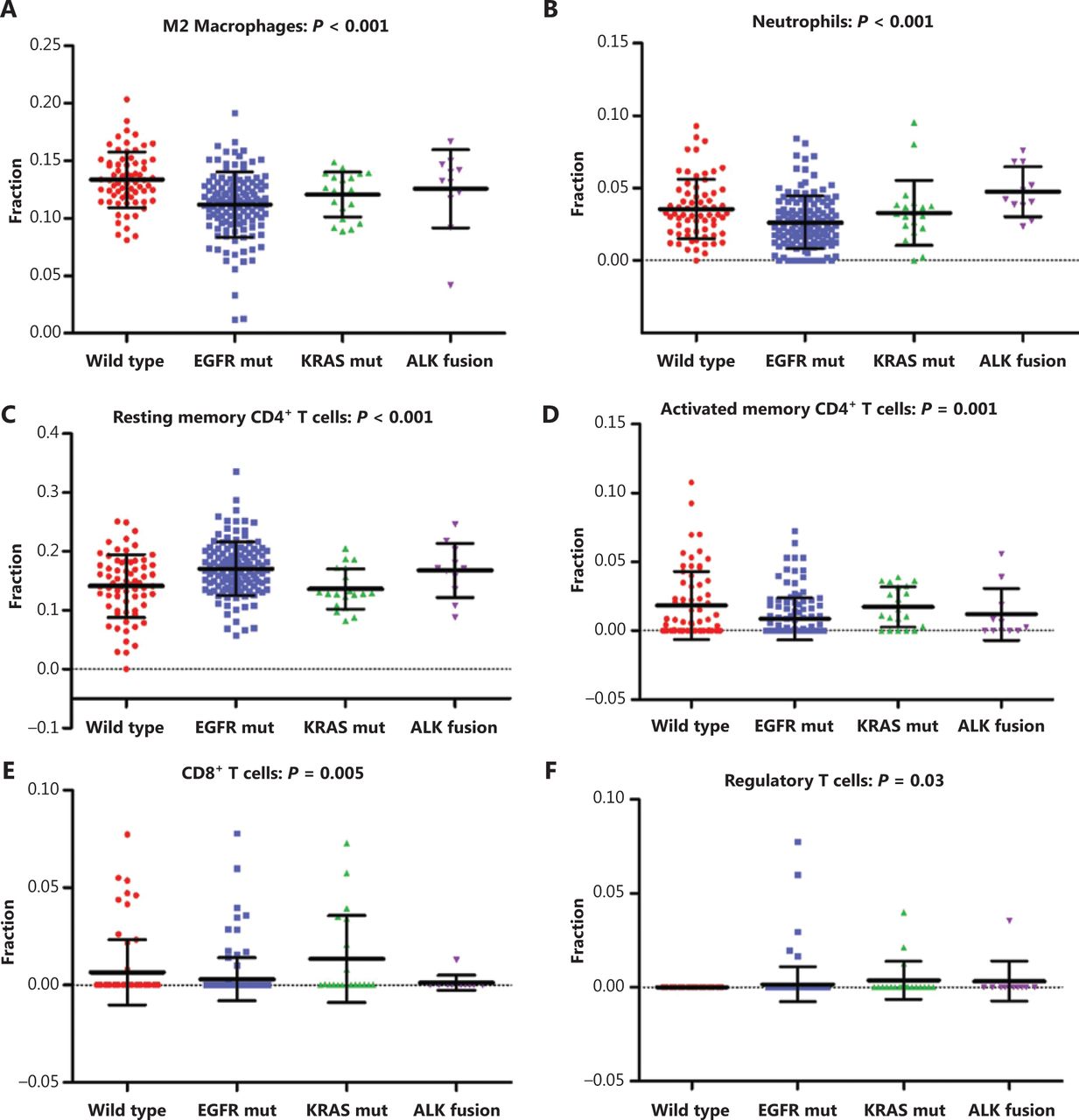
  • Expression of 6 infiltrated immune cells in 4 molecular subgroups of non-small cell lung cancer (NSCLC) patients. (A–F) Scatter plots of the expression of the specific immune cell types, including M2 macrophages (A), neutrophils (B), resting memory CD4+ T cells (C), activated memory CD4+ T cells (D), CD8+ T cells (E), and regulatory T cells (F), among molecular subgroups of NSCLC patients. EGFR mut, EGFR mutation; KRAS mut, KRAS mutation.
    • Download figure
    • Open in new tab
    • Download powerpoint
    Figure 6

    Expression of 6 infiltrated immune cells in 4 molecular subgroups of non-small cell lung cancer (NSCLC) patients. (A–F) Scatter plots of the expression of the specific immune cell types, including M2 macrophages (A), neutrophils (B), resting memory CD4+ T cells (C), activated memory CD4+ T cells (D), CD8+ T cells (E), and regulatory T cells (F), among molecular subgroups of NSCLC patients. EGFR mut, EGFR mutation; KRAS mut, KRAS mutation.

Supplementary Materials

  • Figures
  • [cbm-17-768-s001.pdf]
PreviousNext
Back to top

In this issue

Cancer Biology and Medicine: 17 (3)
Cancer Biology & Medicine
Vol. 17, Issue 3
15 Aug 2020
  • Table of Contents
  • Index by author
Print
Download PDF
Email Article

Thank you for your interest in spreading the word on Cancer Biology & Medicine.

NOTE: We only request your email address so that the person you are recommending the page to knows that you wanted them to see it, and that it is not junk mail. We do not capture any email address.

Enter multiple addresses on separate lines or separate them with commas.
Molecular heterogeneity of anti-PD-1/PD-L1 immunotherapy efficacy is correlated with tumor immune microenvironment in East Asian patients with non-small cell lung cancer
(Your Name) has sent you a message from Cancer Biology & Medicine
(Your Name) thought you would like to see the Cancer Biology & Medicine web site.
Citation Tools
Molecular heterogeneity of anti-PD-1/PD-L1 immunotherapy efficacy is correlated with tumor immune microenvironment in East Asian patients with non-small cell lung cancer
Runsen Jin, Chengming Liu, Sufei Zheng, Xinfeng Wang, Xiaoli Feng, Hecheng Li, Nan Sun, Jie He
Cancer Biology & Medicine Aug 2020, 17 (3) 768-781; DOI: 10.20892/j.issn.2095-3941.2020.0121

Citation Manager Formats

  • BibTeX
  • Bookends
  • EasyBib
  • EndNote (tagged)
  • EndNote 8 (xml)
  • Medlars
  • Mendeley
  • Papers
  • RefWorks Tagged
  • Ref Manager
  • RIS
  • Zotero
Share
Molecular heterogeneity of anti-PD-1/PD-L1 immunotherapy efficacy is correlated with tumor immune microenvironment in East Asian patients with non-small cell lung cancer
Runsen Jin, Chengming Liu, Sufei Zheng, Xinfeng Wang, Xiaoli Feng, Hecheng Li, Nan Sun, Jie He
Cancer Biology & Medicine Aug 2020, 17 (3) 768-781; DOI: 10.20892/j.issn.2095-3941.2020.0121
Twitter logo Facebook logo Mendeley logo
  • Tweet Widget
  • Facebook Like
  • Google Plus One

Jump to section

  • Article
    • Abstract
    • Introduction
    • Materials and methods
    • Results
    • Discussion
    • Conclusions
    • Supporting Information
    • Acknowledgments
    • Footnotes
    • References
  • Figures & Data
  • Info & Metrics
  • References
  • PDF

Related Articles

  • No related articles found.
  • Google Scholar

Cited By...

  • Eliciting pyroptosis to fuel cancer immunotherapy: mechanisms and strategies
  • Google Scholar

More in this TOC Section

  • Myeloid cell reprogramming combined with zoledronic acid effectively suppresses bone metastasis
  • Exosomal EPHA2 transfers metastatic potential by stabilizing TGF-βRI and activating the TGF-β/SMAD3 signaling pathway in breast cancer
  • Efficacy and safety of first-line osimertinib in Chinese patients with EGFR-mutated advanced non-small cell lung cancer: a prospective, multicenter, non-interventional study (FLOURISH)
Show more Original Article

Similar Articles

Keywords

  • NSCLC
  • East Asian
  • oncogene mutations
  • PD-1/PD-L1 inhibitors
  • immune microenvironment

Navigate

  • Home
  • Current Issue

More Information

  • About CBM
  • About CACA
  • About TMUCIH
  • Editorial Board
  • Subscription

For Authors

  • Instructions for authors
  • Journal Policies
  • Submit a Manuscript

Journal Services

  • Email Alerts
  • Facebook
  • RSS Feeds
  • Twitter


© 2026 Cancer Biology & Medicine

Powered by HighWire