

Main menu

  • Home
  • About
    • About CBM
    • Editorial Board
    • Announcement
  • Articles
    • Ahead of print
    • Current Issue
    • Archive
    • Collections
    • Cover Story
  • For Authors
    • Instructions for Authors
    • Resources
    • Submit a Manuscript
  • For Reviewers
    • Become a Reviewer
    • Instructions for Reviewers
    • Resources
    • Outstanding Reviewer
  • Subscription
  • Alerts
    • Email Alerts
    • RSS Feeds
    • Table of Contents
  • Contact us
  • Other Publications
    • cbm

User menu

  • My alerts

Search

  • Advanced search
Cancer Biology & Medicine
  • Other Publications
    • cbm
  • My alerts
Cancer Biology & Medicine

Advanced Search


  • Home
  • About
    • About CBM
    • Editorial Board
    • Announcement
  • Articles
    • Ahead of print
    • Current Issue
    • Archive
    • Collections
    • Cover Story
  • For Authors
    • Instructions for Authors
    • Resources
    • Submit a Manuscript
  • For Reviewers
    • Become a Reviewer
    • Instructions for Reviewers
    • Resources
    • Outstanding Reviewer
  • Subscription
  • Alerts
    • Email Alerts
    • RSS Feeds
    • Table of Contents
  • Contact us
  • Follow cbm on Twitter
  • Visit cbm on Facebook
Review ArticleReview

Restricting carbohydrates to fight head and neck cancer—is this realistic?

Rainer J. Klement
Cancer Biology & Medicine September 2014, 11 (3) 145-161; DOI: https://doi.org/10.7497/j.issn.2095-3941.2014.03.001
Rainer J. Klement
1Department of Radiotherapy and Radiation Oncology, Leopoldina Hospital, Schweinfurt 97421, Germany
  • Find this author on Google Scholar
  • Find this author on PubMed
  • Search for this author on this site
  • For correspondence: rainer_klement{at}gmx.de
  • Article
  • Figures & Data
  • Info & Metrics
  • References
  • PDF
Loading

Article Figures & Data

Figures

  • Tables
  • Figure 1
    • Download figure
    • Open in new tab
    • Download powerpoint
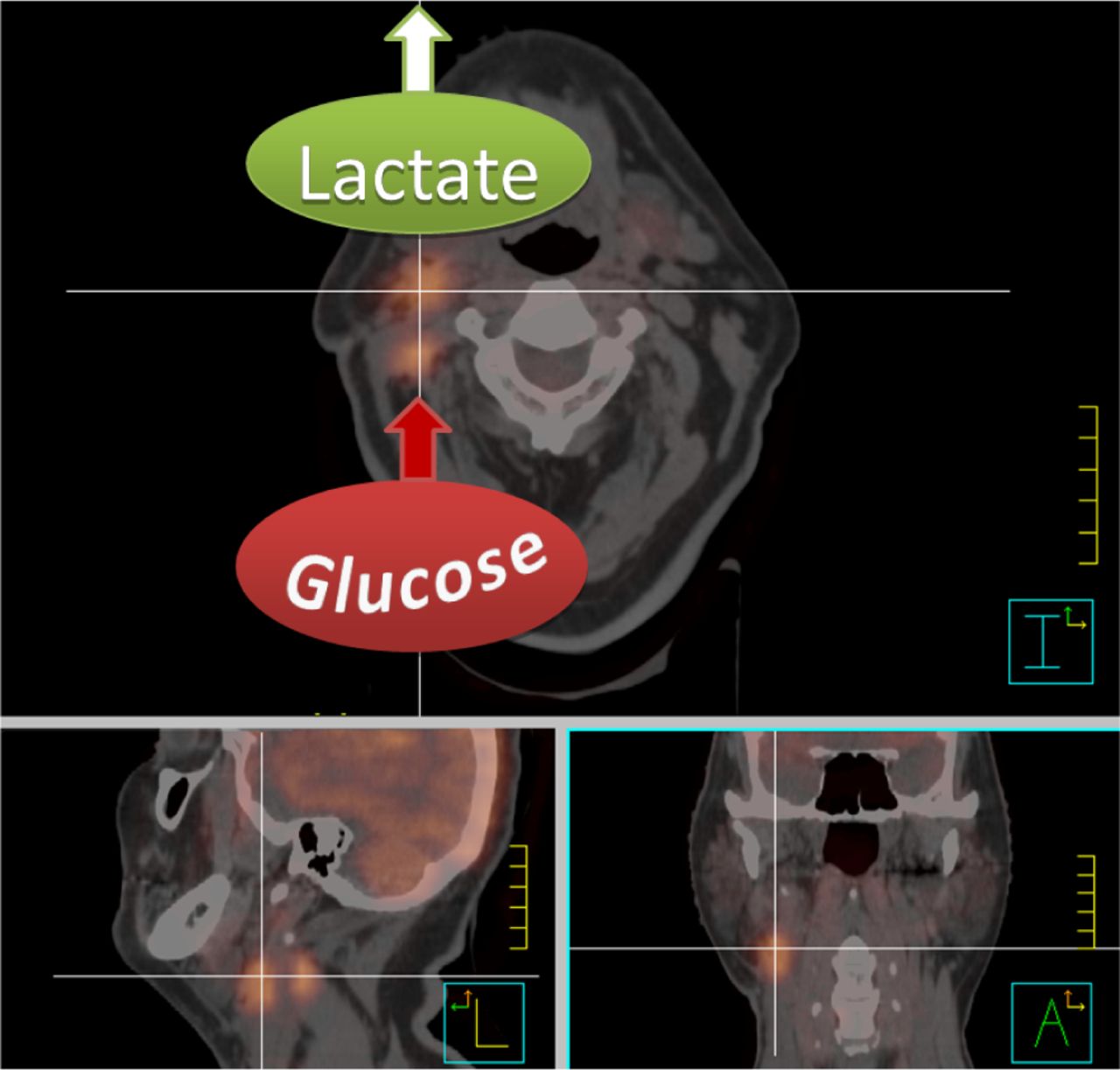
    Figure 1

    Fusion image of a radiotherapy planning CT and FDG-PET scan of a patient with a primary right-sided cT1 cN2b tonsillar squamous cell carcinoma after tonsillectomy. The high FDG uptake of the right lymph node conglomerates is indicative of highly glycolytic metastasis. Note, however, that FDG-PET only measures glucose uptake and conversion into glucose-6-phosphate, and can therefore not discriminate between lactate production or feeding of glycolysis intermediates and end products into the pentose phosphate pathway or citric acid cycle. The high lactate release which can be measured with other techniques such as magnetic resonance spectroscopy is, however, indicated for illustrative purposes since it is characteristic for aggressive metastasis.

  • Figure 2
    • Download figure
    • Open in new tab
    • Download powerpoint
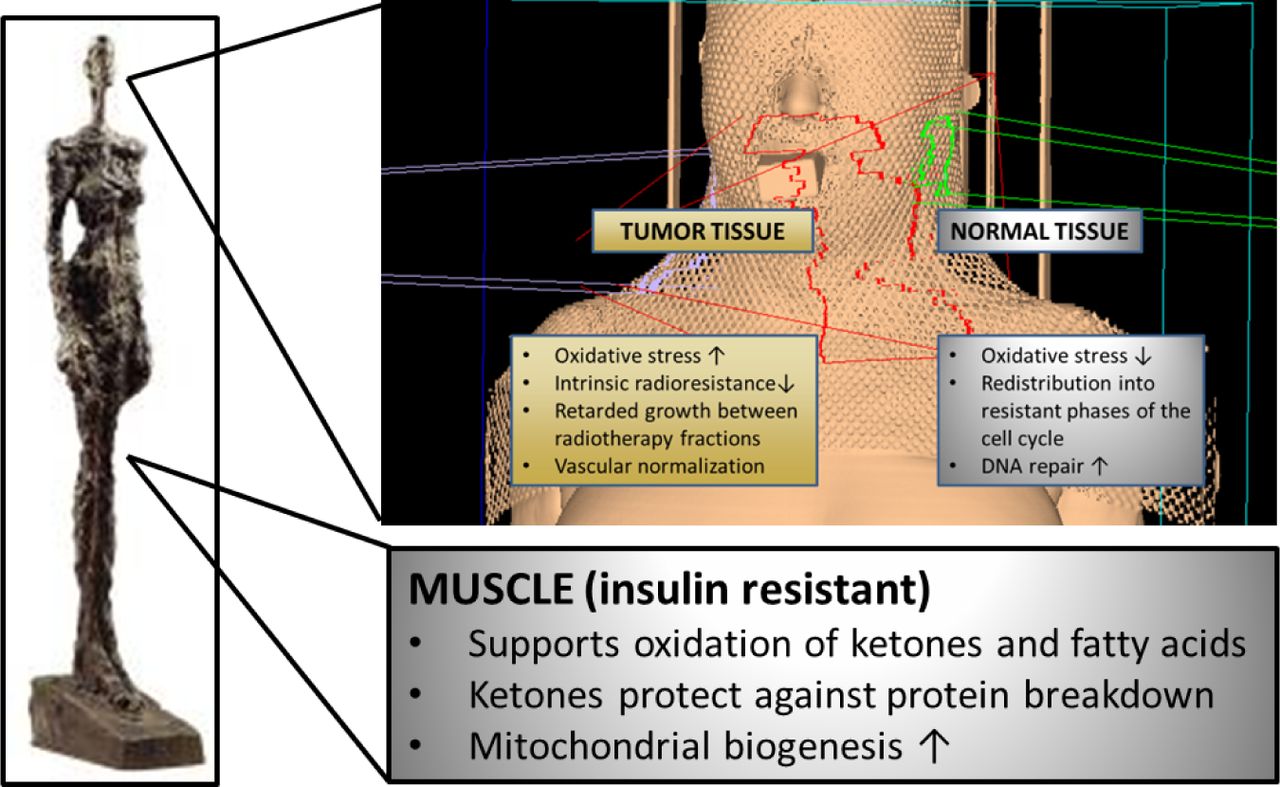
    Figure 2

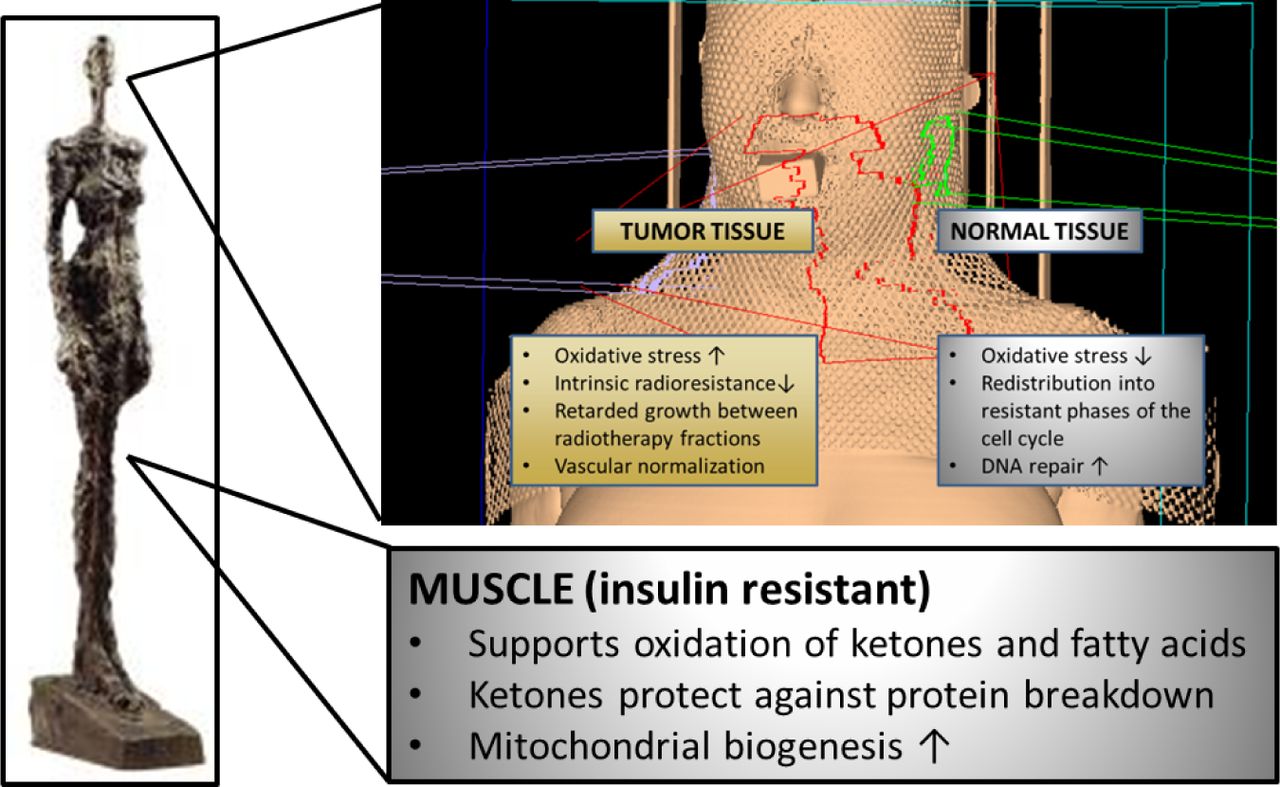
    Putative effects of CHO restriction on normal and tumor tissue. During radiotherapy CHO restriction may induce a differential stress response between normal and tumor cells such that the former experience protection from and the latter sensitization to ionizing radiation. Additionally, through the elevation of ketone bodies and fatty acids, CHO restriction helps to conserve muscle tissue.

  • Figure 3
    • Download figure
    • Open in new tab
    • Download powerpoint
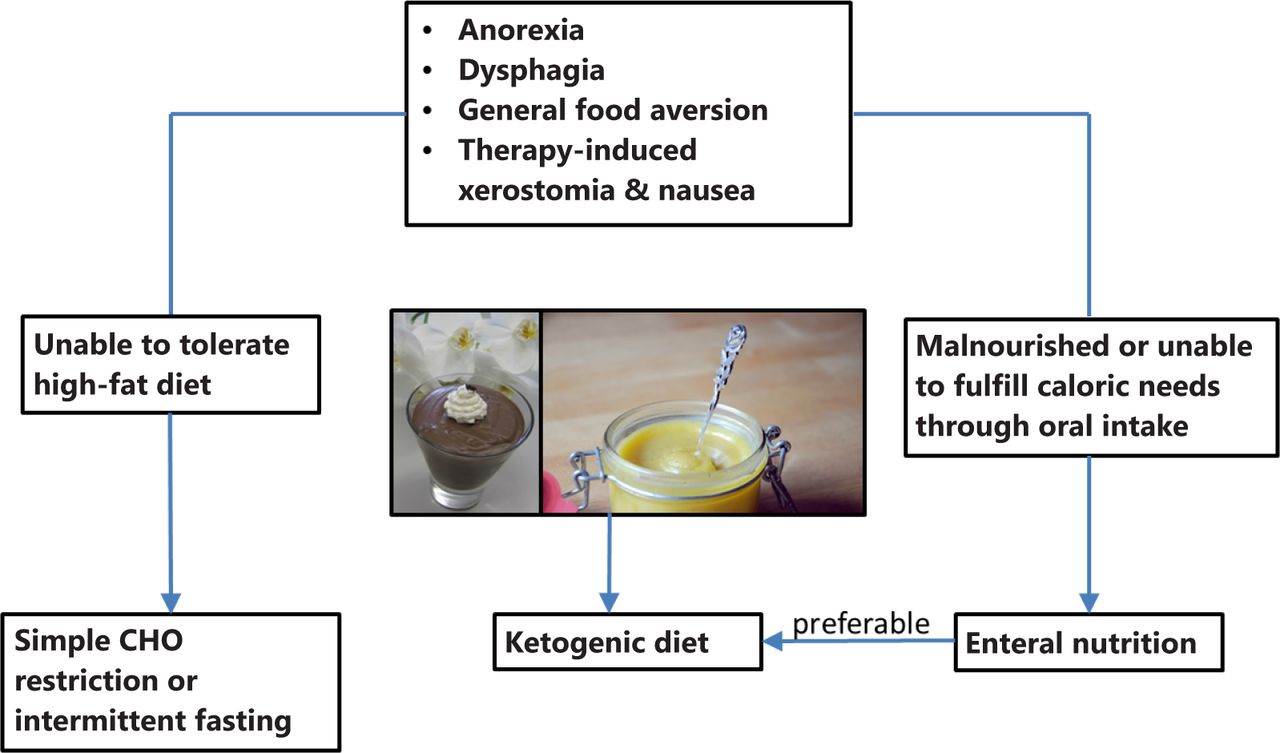
    Figure 3

    Flow chart showing the proposed implementation of a low CHO diet for the HNC patient. The pictures show foods compatible with a ketogenic diet that have a creamy texture and thus are easy to swallow.

Tables

  • Figures
    • View popup
    Table 1

    Common genetic mutations in HNSCC and their implication for tumor cell metabolism

    GeneFrequency (%)45Implications for metabolism
    Loss of function mutations/deletions
    TP5350-80Loss of p53 leads to nuclear and mitochondrial DNA instability, increased oxidative stress, decrease of OXPHOS and up-regulation of glycolysis (reviewed in46,47)
    NOTCH114-15Hypoactive Notch diminishes p53 levels and attenuates mitochondrial function, causing a switch to glycolysis and dependence on glucose48
    PTEN7PTEN counteracts glycolysis by reversing the PI3K-mediated conversion of phosphatidylinositol1,4-biphosphate (PIP2) to phosphatidylinositol1,4,5-triphosphate (PIP3) that is required to activate Akt-mTOR signaling. Loss of PTEN therefore increases Akt activation. PTEN also counteracts glutaminolysis by reducing glutaminase levels through a PI3K-independent pathway49
    Gain of function mutations/amplifications
    PIK3CA6-20PIK3CA encodes p110α, an isoform of the 110-kDa catalytic subunit of the class 1A phosphatidylinositol-3-kinase (PI3K). The PI3K-Akt-mTOR pathway is one of the most frequently hyperactivated signaling cascades in tumor cells. Enhanced Akt signaling induces a Warburg phenotype and increases the coupling of glycolysis to the mitochondrial citric acid cycle which yields intermediates for biosynthetic pathways and NADH as the primary electron donor for OXPHOS (reviewed in50)
    HRAS4-5HRAS encodes the small GTPase H-Ras, a member of the Ras superfamily of enzymes that become active when bound to GTP. Besides other pathways important for cell survival and proliferation, Ras-GTP directly acivates PI3K p110. Oncogenic H-Ras activation diminishes mitochondrial respiration, rendering transformed cells depend on glucose to fuel glycolysis51
    • View popup
    Table 2

    Targeting tumor glycolysis through carbohydrate restriction

    Factors promoting glycolysisCHO restriction as a metabolic strategy to target these factors
    High blood glucose levels (Up-regulation of glycolytic enzymes)Blood glucose ↓, fatty acids ↑ (Fatty acids inhibit key glycolytic enzymes)
    HypoxiaBlood glucose ↓, ketones ↑ (Poor nutrient supply to hypoxic cells; hypoxic cells unable to efficiently oxidize ketones)
    Oncogenic signaling (Insulin/IGF-1-PI3K-Akt-mTOR)Blood glucose ↓, insulin ↓ (Counteracts PI3K pathway; also activates AMPK, inhibiting mTOR)
    Ketones ↑ (Class I and II HDAC inhibitors)
    Inflammation (High blood glucose levels and ROS promote inflammatory cytokine release)Blood glucose ↓ (Decreases ROS and inflammation)
PreviousNext
Back to top

In this issue

Cancer Biology and Medicine: 11 (3)
Cancer Biology & Medicine
Vol. 11, Issue 3
1 Sep 2014
  • Table of Contents
  • Index by author
Print
Download PDF
Email Article

Thank you for your interest in spreading the word on Cancer Biology & Medicine.

NOTE: We only request your email address so that the person you are recommending the page to knows that you wanted them to see it, and that it is not junk mail. We do not capture any email address.

Enter multiple addresses on separate lines or separate them with commas.
Restricting carbohydrates to fight head and neck cancer—is this realistic?
(Your Name) has sent you a message from Cancer Biology & Medicine
(Your Name) thought you would like to see the Cancer Biology & Medicine web site.
Citation Tools
Restricting carbohydrates to fight head and neck cancer—is this realistic?
Rainer J. Klement
Cancer Biology & Medicine Sep 2014, 11 (3) 145-161; DOI: 10.7497/j.issn.2095-3941.2014.03.001

Citation Manager Formats

  • BibTeX
  • Bookends
  • EasyBib
  • EndNote (tagged)
  • EndNote 8 (xml)
  • Medlars
  • Mendeley
  • Papers
  • RefWorks Tagged
  • Ref Manager
  • RIS
  • Zotero
Share
Restricting carbohydrates to fight head and neck cancer—is this realistic?
Rainer J. Klement
Cancer Biology & Medicine Sep 2014, 11 (3) 145-161; DOI: 10.7497/j.issn.2095-3941.2014.03.001
Twitter logo Facebook logo Mendeley logo
  • Tweet Widget
  • Facebook Like
  • Google Plus One

Jump to section

  • Article
    • Abstract
    • Introduction
    • The sweet tooth of HNCs
    • Genetic and epigenetic alterations promote aerobic glycolysis
    • Vulnerability of HNC cells to CHO restriction
    • CHO restriction during radiation treatment
    • CHO restriction to positively influence body composition
    • Discussion: is CHO restriction in HNC patients realistic?
    • Acknowledgements
    • Footnotes
    • References
  • Figures & Data
  • Info & Metrics
  • References
  • PDF

Related Articles

  • No related articles found.
  • Google Scholar

Cited By...

  • Survival outcomes of rectal and head and neck cancer patients receiving radio-(chemo)therapy with a ketogenic diet. Results from a controlled clinical study (KETOCOMP)
  • Google Scholar

More in this TOC Section

  • Gut microecology empowers cancer immunotherapy: commensal microbiota-mediated mechanisms and translational prospects of PD-1/PD-L1 therapy
  • Innovative cross-intervention: copper ions and metabolic pathways in cancer therapy
  • Primary cilia in cancer: structures, functions, mechanisms, and therapeutic implications
Show more Review

Similar Articles

Keywords

  • Ketogenic diet (KD)
  • head and neck neoplasms
  • diet
  • carbohydrate restricted (CHO restricted)
  • nutritional support

Navigate

  • Home
  • Current Issue

More Information

  • About CBM
  • About CACA
  • About TMUCIH
  • Editorial Board
  • Subscription

For Authors

  • Instructions for authors
  • Journal Policies
  • Submit a Manuscript

Journal Services

  • Email Alerts
  • Facebook
  • RSS Feeds
  • Twitter


© 2026 Cancer Biology & Medicine

Powered by HighWire